
Walk into any hunting store and you’ll see dozens of camo prints that all claim to be the best one for “the woods.” In reality, the right camo pattern depends on your specific terrain, the season, the light conditions you’ll be hunting in, and even how far your typical shot is. Picking the wrong one doesn’t ruin a hunt, but picking the right one genuinely helps you stay unseen longer.
SaveItMore is reader-supported. If you buy through a link on this page we may earn a commission, at no extra cost to you.
This guide breaks down how camo patterns actually work, what separates one style from another, and how to match a pattern to the terrain and season you hunt most.
How Camo Actually Works (It’s Not Just Color)
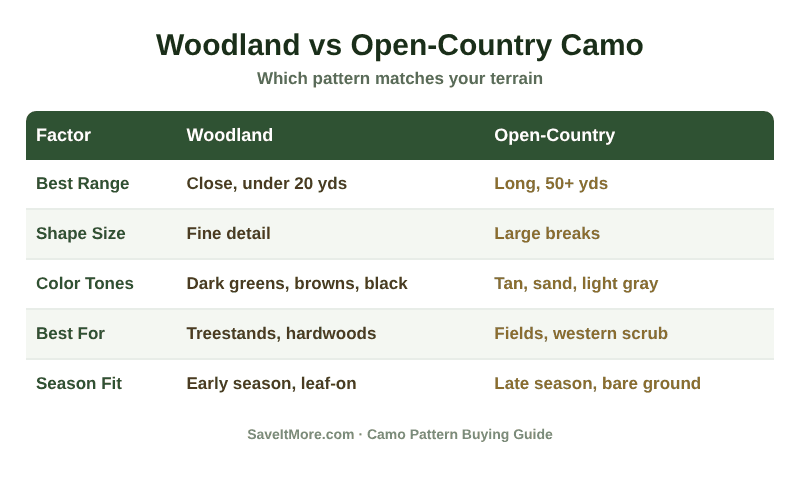
Effective camouflage relies on three things working together: color matching the background, pattern “noise” that breaks up your outline, and contrast that mimics natural shadows and light gaps. A camo pattern can be the right color palette and still fail if the shapes are too large or too small for the distance game will actually see you from. Close-range patterns use fine detail that blends well under ten yards; open-country patterns use larger, high-contrast shapes designed to break up a silhouette from fifty-plus yards out.
Matching a Camo Pattern to Your Terrain
Dense Woods and Treestand Hunting
In thick hardwoods or a treestand, most encounters happen at close range, so detail-heavy patterns with layered browns, greens and black work well. Because you’re often elevated and backlit by canopy, patterns with vertical elements that mimic bark and branches tend to blend better than horizontal designs.
Open Fields and Western Terrain
Wide-open country calls for a different approach entirely — lighter, sandier tones and larger shape breaks that read correctly from longer distances. A dense, dark woodland pattern can actually stand out against tan grass and rock instead of disappearing into it.
Early Season vs Late Season
Early-season patterns generally lean greener to match foliage still on the trees, while late-season designs shift toward browns, grays and bare-branch tones once leaves drop. Snow camo is its own category entirely, and mixing a green pattern into a snowy hunt defeats the purpose no matter how good the pattern is on paper.

Camo Pattern Choice Also Depends on How You Hunt
Bowhunters and rifle hunters often benefit from different camo strategies, mostly because of the distances involved. Bowhunting generally means closing to within a few dozen yards at most, so fine detail and close-range blending matter far more than long-range silhouette breaking. Rifle hunters taking shots at 100+ yards can get away with a slightly less detailed pattern, since at that distance broader shape and color matching to the background does most of the work anyway.
Ground blind hunters have another consideration: a pattern that blends well against the blind’s exterior fabric, not just the surrounding terrain, since your silhouette will often be framed against the blind itself rather than open woods.
Fabric and Build Quality Matter as Much as the Print
A great camo pattern printed on thin, noisy fabric still gets you busted when you move. A few things worth checking before buying:
- Noise level: Soft-shell and brushed fabrics move quietly; stiff, cheap polyester can rustle loudly enough to spook game at close range.
- Weather rating: Water-resistant and windproof layers matter more in late season, when you’re sitting still for hours in cold conditions.
- Scent control features: Some camo clothing lines add odor-control treatments to the fabric, which can matter as much as visual concealment for some species.
- Layering fit: Buy outer layers roomy enough to fit over a base layer and mid layer without restricting your draw or shot.
Building a Full Camo System, Not Just One Jacket
A single jacket rarely does the whole job. Most serious hunters end up assembling a layered system: a quiet, scent-controlled base layer, an insulating mid layer for cold sits, and an outer shell matched to the terrain and weather of that specific hunt. Brands that sell across all three categories, rather than just outerwear, make it easier to match the camo pattern consistently across every layer, which matters if any layer is visible at the collar, cuffs or waist while you’re in the field.
Accessories count too — a mismatched face mask, gloves or pack cover can undo an otherwise well-matched system, so it’s worth checking that your accessories use the same pattern family as your main outerwear rather than whatever was on sale.
Where to Find Camo Gear and Current Discounts
Camo clothing and outerwear add up fast once you’re buying a full system for multiple seasons. King’s Camo is a well-known brand for both woodland and open-country patterns, and it’s worth checking SaveItMore’s live King’s Camo deals before you order, since an active promo code can take a real chunk off a multi-piece order — there are 90+ offers listed right now. If you’re shopping for a gift rather than your own gear, our camping gift ideas and practical gift ideas for men guides both include outdoor gear picks that pair well with a camo clothing order.
Common Mistakes When Choosing a Camo Pattern
- Buying one pattern for every hunt: A single all-purpose camo compromises on every terrain instead of excelling at one. If you hunt multiple states or seasons, budget for at least two patterns.
- Ignoring your local foliage: A pattern designed for Southern pine forests won’t necessarily work in Northern hardwoods or Western scrub. Match the pattern’s design intent to where you actually hunt.
- Overlooking movement noise: Visual concealment means nothing if the fabric gives away your position with every step.
- Skipping a test walk: Try the gear in low light near your actual hunting ground before the season starts, not for the first time on opening morning.
Frequently Asked Questions
Is one camo pattern enough for most hunters?
If you hunt mostly one type of terrain in one season, a single well-matched camo pattern is usually enough. Hunters who travel between regions or hunt early and late season benefit from owning at least two different patterns.
Does camo pattern matter more than scent control?
For most big game, wind and scent control matter more than visual camouflage, since many species rely on smell before sight. That said, a good camo pattern still matters for avoiding detection by sight at close range or from elevated stands.
What’s the difference between woodland and open-country camo?
Woodland patterns use smaller, detailed shapes and darker tones suited to close-range concealment among trees and brush. Open-country patterns use larger shape breaks and lighter tones designed to read correctly at longer distances across fields or scrubland.
Can I use the same camo for turkey and deer hunting?
Many patterns work for both, but turkey hunting often happens at closer range with the hunter on the ground, so a detail-heavy pattern tends to perform better than an open-country design built for long sightlines.
How often should I replace hunting camo clothing?
Quality camo outerwear can last many seasons if cared for properly, but check zippers, seam taping and insulation loft each year, since worn-out insulation and failed water resistance affect comfort and warmth long before the pattern itself fades.
Does washing camo clothing affect its scent control or pattern?
Regular detergent with fragrance and brighteners can degrade scent-control treatments and, over many washes, dull the contrast in a printed pattern. Most camo clothing brands recommend scent-free, UV-brightener-free detergent specifically to protect both the treatment and the print over time.