



Learning to measure your foot size at home takes about five minutes and saves you the single most common reason online shoe orders get returned: the shoe simply does not fit. All you need is a sheet of paper, a pen, a ruler and a wall.
This guide walks through the five steps, gives you the conversion chart that turns a measurement in centimetres into a US, UK or EU size, and covers the small mistakes that quietly cost you half a size — which is more than enough to make a pair unwearable.
What you need
Nothing you do not already own:
- Two sheets of paper, larger than your foot (A4 works for most adults).
- A pen or pencil. Hold it upright, not at an angle.
- A ruler or tape measure with millimetre markings.
- A wall, and the socks you actually intend to wear with the shoes.
Having someone else do the tracing is easier and more accurate, because bending over shifts your weight and changes the shape of your foot. If you are on your own, it still works — just take your time.
How to measure your foot size at home: the five steps
Step 1 — Tape the paper down against a wall
Put the paper on a hard floor with one edge flat against the skirting board. Carpet gives a soft, uneven result; a tiled or wooden floor is better. Tape the paper down so it cannot slide while you are standing on it.
Step 2 — Stand on it with your heel to the wall
Put your full weight on the foot, with your heel touching the wall and your leg straight. Standing matters: a foot under load spreads out and is measurably longer than the same foot when you are sitting down. This is the single biggest source of error in home measuring.
Step 3 — Mark the longest toe
Have someone mark the paper at the tip of your longest toe. For plenty of people that is the second toe, not the big one — so check rather than assume.
Keep the pen vertical. A pen held at an angle adds a few millimetres to the reading, and a few millimetres is a real fraction of a size.
Step 4 — Measure heel to mark
Take the paper away and measure the straight-line distance from the paper’s edge (where your heel was) to the mark. Write down the number in centimetres or inches.
While you have the paper out, also measure the widest part across the ball of your foot. You will want that number later if you have ever found shoes tight across the toes.
Step 5 — Repeat for the other foot, then use the larger one
Most people have one foot slightly larger than the other, and a difference of half a size is completely normal. Measure both, and buy for the larger foot. A shoe that is a touch roomy can be fixed with an insole or a thicker sock. A shoe that is too short cannot be fixed at all.
Turning your measurement into a size
Once you have a number in centimetres, the chart does the rest.
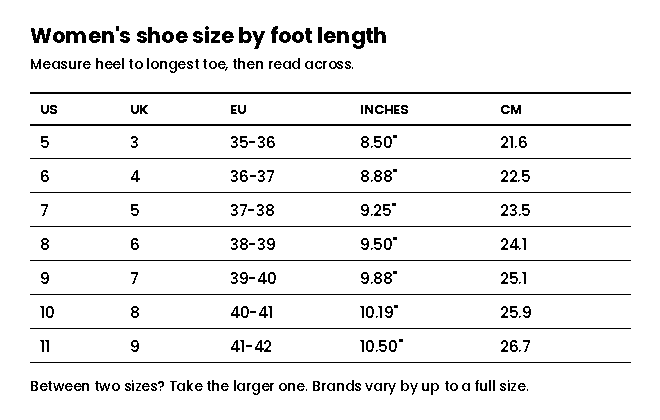
Two things to know before you read across:
Do not add anything to your measurement. Some guides tell you to add a centimetre “for wiggle room”. Do not. Standard size charts already build in the allowance between your foot and the inside of the shoe. Adding your own on top is how people end up a full size too big.
If you land between two sizes, take the larger one. The gap between half sizes is only a few millimetres, and a slightly roomy shoe is a far smaller problem than a slightly short one.
Four mistakes that ruin the measurement
Each of these is worth roughly half a size on its own, and they stack.
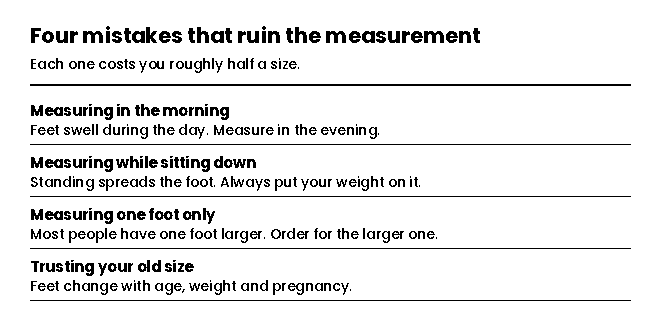
Measuring first thing in the morning. Feet swell over the course of a day, especially if you are on them a lot. A measurement taken at 7am can be noticeably smaller than the same foot at 6pm. Measure in the late afternoon or evening, which is closer to how your foot will be when you are actually wearing the shoes.
Measuring while sitting down. Covered above, but it is worth repeating because it is the most common error. Sitting takes the load off the foot and shortens it. Always stand.
Measuring one foot and assuming the other matches. They usually do not. Measure both.
Trusting the size you have always worn. Feet change. They lengthen and widen with age as the ligaments relax, they change with significant weight gain or loss, and they often change permanently after pregnancy. The size you wore at twenty is not a reliable guide at forty.
Width matters as much as length
Length gets all the attention, but plenty of “this shoe does not fit” problems are actually width problems wearing a length disguise.
If shoes in your correct length regularly feel tight across the ball of your foot, pinch your little toe, or leave marks along the sides, you likely need a wider fitting rather than a longer shoe. Going up a size to solve a width problem gives you a shoe that is both loose at the heel and still tight where it matters.
Width is where that second measurement from Step 4 earns its keep. Many brands publish a width chart alongside their length chart, and some offer explicit wide fittings. A shoe that is roughly 6mm wider in the toe box is the usual difference between a regular and a wide.
Foot shape matters too. A foot with a high instep needs more depth, not more length, and will feel tight in a low-cut shoe even at the correct size. Lace-ups and adjustable straps forgive this; slip-ons and ballet flats do not.
Why the same size fits differently across brands
This is the part that frustrates people most, and it is worth understanding rather than fighting.
Shoe sizing is not a regulated standard in the way that, say, metric measurements are. Each manufacturer designs around its own last — the foot-shaped form a shoe is built on. Two brands can label a shoe “US 8” and produce shoes that differ by a full size in practice.
Athletic brands in particular often run narrow or short compared to general size charts, which is why a size that fits you in trainers may not fit in boots. The chart above is a solid general reference, but it is a starting point, not a verdict.
The practical rule: once you have measured, always check the specific brand’s own chart against your centimetre measurement rather than ordering by the size number you usually wear. Most retailers publish one, and it takes ten seconds to read.
It is also worth reading reviews for the phrase “runs small” or “runs large” before you order. Where dozens of buyers say the same thing, believe them.
Measuring children’s feet
The method is the same, but the stakes and the timing are different.
Children’s feet grow in irregular bursts rather than steadily, so a measurement taken three months ago is not current. Measure every two to three months for toddlers and pre-schoolers, and every four months or so for older children.
Leave a thumb’s width — roughly 1 to 1.5 cm — of growing room beyond the longest toe. That is the one case where adding to the measurement is correct, and it is why children’s charts often build it in explicitly.
Resist the urge to buy two sizes up to make them last. A shoe that is far too long makes a child trip, changes how they walk, and wears out unevenly before it ever fits properly.
What to do when the shoes arrive
Measuring well gets you most of the way. The final check happens at home, and it takes a minute.
Try them on in the evening, wearing the socks you intend to wear with them. Stand up, put your full weight on them, and check three things: about a thumb’s width between your longest toe and the end; no pinching across the widest part; and your heel staying put rather than lifting as you walk.
Walk on carpet, not outside, until you are sure you are keeping them. Most retailers will not accept a return once the sole shows wear.
A shoe should feel right immediately. “Breaking in” applies to leather softening and moulding slightly to your foot — it does not rescue a shoe that is the wrong size.
Keeping the cost down
There is a direct link between measuring properly and spending less, and it is not subtle: every return costs you time, sometimes return postage, and occasionally the discount you bought at if the offer has expired by the time you reorder.
Before ordering, it is worth checking two things beyond the price. First, whether the retailer offers free returns — with shoes this matters more than a small price difference, because the odds of needing one are never zero. Second, whether there is a live offer you are missing. Our Dream Pairs promo codes page lists the current offers for one of the larger value footwear brands, covering men’s, women’s and kids’ ranges.
One honest note on shopping the value end of the footwear market: the biggest headline percentage is rarely the best deal. Free shipping thresholds, multi-buy tiers and first-order offers frequently beat a larger code that excludes half the catalogue. Read what a code actually applies to before assuming it is the best one on the page. Our guide to finding verified coupon codes for your favourite stores covers where working codes genuinely come from.
Frequently asked questions
What is the best time of day to measure your feet?
Late afternoon or evening. Feet swell through the day, so an evening measurement reflects how your foot will be for most of the time you are wearing the shoe.
Should I measure in socks or barefoot?
In the socks you will wear with the shoes. For trainers and boots that usually means a normal or thick sock; for sandals and flats, measure barefoot. A thick sock can add a few millimetres, which is enough to matter.
Is it normal for one foot to be bigger than the other?
Completely normal — most people have a difference, often around half a size. Always buy for the larger foot and pad the other side if needed.
Can I measure my foot size at home with a tape measure instead of paper?
You can, but it is less accurate. Wrapping a tape around a standing foot is awkward and easy to do inconsistently. The paper-and-wall method removes the guesswork, which is why it is the one most fitters use.
Does the chart work for men’s and women’s shoes?
The foot length measurement is the same; only the size labelling differs. Men’s US sizing typically runs about 1.5 sizes below women’s for the same foot length, and UK and EU charts differ again. Always match your centimetre measurement to the specific chart for the shoe you are buying.
My measurement falls exactly between two sizes. Which do I pick?
The larger one. A slightly roomy shoe can be adjusted with an insole or a thicker sock; a short one cannot be adjusted at all.
How often should I re-measure?
For adults, once a year is plenty, and sooner after significant weight change or pregnancy. For children, every two to four months depending on age.
The bottom line
The reliable way to measure your foot size at home is not complicated — it is just done carefully. Stand up, keep the pen vertical, measure both feet in the evening, and use the larger one.
Then do the step most people skip: match your centimetre measurement to the specific brand’s chart rather than ordering the size number you usually wear. That single habit removes most of the reason shoes get sent back.
Five minutes with a sheet of paper is a better investment than any return label.
If you are buying shoes for a wedding or a formal event, the same principle applies to the outfit: our guide to measuring yourself for a dress covers the four numbers that decide whether a made-to-order dress fits, and how to measure yourself for a suit at home does the same for menswear, including the drop rule that links jacket and trousers.
Size conversions above follow standard general footwear sizing as published by Grivet Outdoors. Individual brands size to their own lasts and can differ by up to a full size — Nike’s own chart is a good example of how much variation is normal. Always check the chart for the shoe you are actually buying.