

Working out how to find her ring size without her knowing is the one part of a proposal you cannot outsource, cannot rush, and cannot ask about directly without giving the whole thing away. It is also the part most people get wrong — not because it is hard, but because the popular tricks passed around online are far less reliable than they sound.
This guide works through nine ways to do it, ranked honestly by how often each one actually lands on the right size. You will also get the measurement chart jewellers use, the five small mistakes that quietly ruin an otherwise careful measurement, and what your options really are if the ring turns up a size too small on the day.
The short answer
The reliable way to find her ring size without her knowing is to borrow a ring she already wears on the correct finger and measure the inside of it. Everything else on this page is a fallback for when you cannot get hold of one.
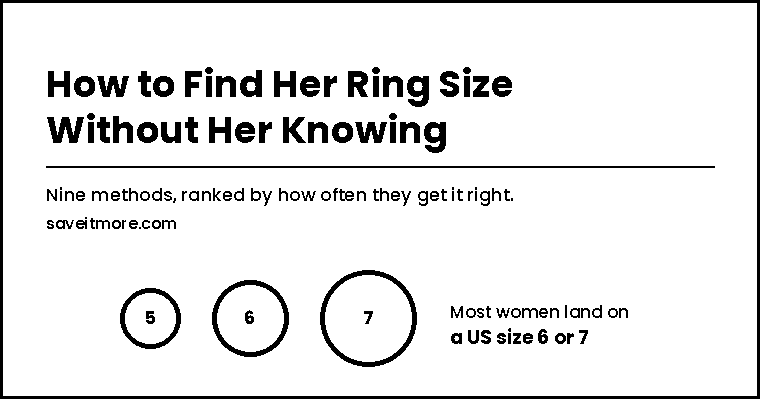
If you have no ring and no time, order a US size 6 or 7 and plan to resize. Those two sizes cover the majority of adult women, and most rings can be adjusted afterwards — with some important exceptions covered further down.
What you are actually trying to measure
Ring size is not a vague style preference. It is a physical measurement of the inside of the band, and every size on the scale is a fixed number of millimetres.
In the US system, each full size step is roughly 0.4 mm of inside diameter. That is a tiny difference — about the thickness of four sheets of paper — which is exactly why guessing by eye almost never works, and why a measurement taken carelessly can land a full size out.
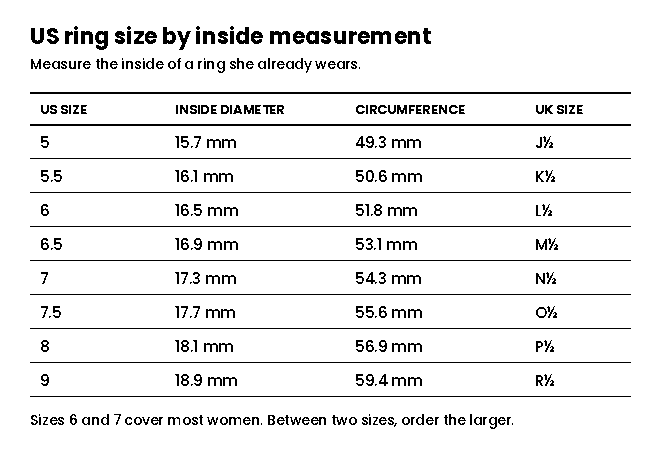
Two numbers matter, and they are easy to confuse:
- Inside diameter — the straight-line distance across the inside of the ring. Easiest to measure with a ruler on a flat surface.
- Inside circumference — the distance around the inside. Easiest to measure if you can wrap something around the finger itself.
Either number gets you to a size. Just be certain which one you have measured, because mixing them up produces a wildly wrong answer rather than a slightly wrong one.
How to find her ring size without her knowing: nine methods
These are the nine practical ways to find her ring size without her knowing, ordered from most reliable to least. Work down the list and stop at the first one you can actually pull off.
1. Borrow a ring she already wears
This is the only method that gives you a real measurement rather than an estimate, and it is worth going to some trouble for.
Take a ring she wears regularly, place it on a flat surface, and measure straight across the inside with a ruler that has millimetre markings. Read the number and find it in the chart above. Measure two or three times and take the reading that comes up most often — a single measurement is easy to get slightly wrong.
The catch that trips people up: the ring must come from the correct finger. Most women wear a ring on the ring finger of the left hand for an engagement, and fingers on the dominant hand are commonly half a size to a full size larger. A ring borrowed from her right hand, or from her index finger, will send you off in the wrong direction with total confidence.
If you are not sure which finger a particular ring lives on, watch for a few days before you take it. And return it quickly — a favourite ring going missing for a week is exactly the kind of thing that starts questions.
2. Press the ring into soap or modelling clay
If you can get the ring for two minutes but not two hours, press it flat into a bar of soap, a lump of modelling clay, or a piece of plasticine until it leaves a clean impression. Then hand the ring straight back and measure the impression at your leisure.
Press it in level and all the way down, so the imprint is a true circle rather than an oval. Measure across the inside edge of the impression, not the outside.
This is very nearly as accurate as measuring the ring itself, and it removes the risk of the ring being missed. If a jeweller is not an option, this is the best fallback on the list.
3. Take the borrowed ring to a jeweller
Any jeweller will size a ring on a mandrel in under a minute, free of charge, and their reading is more precise than yours will be with a ruler. If there is a shop on your way to work, this costs you nothing but the walk.
It has the same weakness as method one — the ring still has to come from the right finger — but it removes the measurement error entirely.
4. Trace the ring’s outline on paper
Popular, and much less reliable than its popularity suggests. A pencil held at a slight angle adds a fraction of a millimetre to the outline, and a fraction of a millimetre is a meaningful share of a whole ring size.
If tracing is genuinely all you can manage, hold the pencil dead vertical, trace the inside of the band rather than the outside, and accept that you have a rough estimate rather than a measurement. Treat the result as “probably around a 6” rather than “a 6”.
5. Compare the ring against your own finger
Slide her ring onto one of your own fingers and mark with a pen exactly where it stops. Later, measure your own finger at that mark — or slide a ring sizer down to it.
The precision is limited by how carefully you mark the spot, but the method works surprisingly well when you only get a few seconds alone with the ring. Some people find it easiest on the little finger.
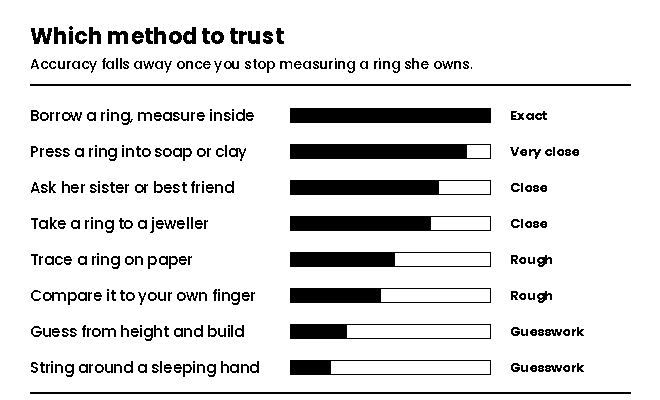
6. Ask her sister, her mother, or her closest friend
Underrated, and often the fastest route to a correct answer when you need to find her ring size without her knowing. Someone close to her may simply know her size, may have bought her a ring before, or can find out in conversation without raising a single eyebrow.
Two things to think about first. One, be honest with yourself about whether that person can keep the secret — there is no undoing it once told. Two, ask them to check rather than to guess. A confidently remembered wrong size is worse than no information at all, because it stops you looking further.
A friend can also do something you cannot: casually suggest trying rings on together while shopping, and quietly note what fits.
7. Give a ring as an ordinary gift first
Buy an inexpensive fashion ring as a birthday or anniversary present, in a style she would wear on a different finger. When she tries it on, you learn something — and if it needs exchanging, she will tell you the size herself while you stand there.
This takes planning weeks ahead, which is why it sits in the middle of the list rather than the top. But if a proposal is still some months away, it is the least suspicious method available, and it gives you a real answer rather than an estimate.
8. Guess from her height and build
You will find charts online claiming to predict ring size from height or dress size. Finger size does correlate loosely with body size, but the spread is wide enough that the prediction is close to useless for an individual.
Use this only to sanity-check an answer you got another way. If every other method points to a 6 and this one says 6, fine. If it is your only source, you are guessing.
9. The string-around-a-sleeping-hand method
This appears in every list of proposal tips and it deserves its place at the bottom of this one.
A relaxed, sleeping hand does not measure the same as an awake one. String stretches. Getting the tension right is impossible when you cannot ask “is that comfortable?” And you have to get the string over a knuckle without waking her — which, if it goes wrong, ruins the surprise in the most memorable way possible.
It is a story, not a technique. If you have any other option, take it.
Five things that quietly ruin a good measurement
Even a careful measurement can be thrown off by things that have nothing to do with how you measured.
Temperature. Fingers shrink in the cold and swell in the heat. A ring measured on a winter morning can feel tight on a summer afternoon. Measure at normal room temperature, and if you are choosing between two sizes, remember that a slightly loose ring is a far smaller problem than one that will not go on.
Time of day. Fingers are usually at their smallest first thing in the morning and their largest in the evening. Late afternoon is a reasonable middle ground.
Salt, alcohol and exercise. All three cause temporary swelling. A measurement taken the morning after a big night out is not a measurement of her actual size.
The knuckle. Some people have knuckles noticeably wider than the base of the finger. A ring that slides over the knuckle easily may then spin loosely once it is on. If her existing rings tend to rotate, mention it to the jeweller — sizing beads or a small insert solve it.
Band width. A wide band sits on more of the finger and feels tighter than a narrow one at the same nominal size. If you are buying something chunky and measuring from a thin band, consider going up a quarter to a half size.
Band width, and why it matters more than people expect
This one is worth its own moment because it catches out people who did everything else right.
Imagine two rings, both a perfect size 6. One is a delicate 2 mm band; the other is a substantial 8 mm band. Put them on the same finger and the wide one will feel distinctly snugger, because it grips a longer stretch of skin and has less room to flex over the knuckle.
So if you measured using a slim everyday ring and you are buying something noticeably wider — a broad wedding band, a chunky statement piece — nudging up by a quarter or half size is usually the right call. Going the other way, from wide to narrow, works in reverse.
What happens if you get it wrong
Most people do get it slightly wrong, and it is rarely a disaster. But the fix is not equally available on every ring, so it is worth knowing before you buy rather than after.
The general rule jewellers work to is about two sizes up or down on a plain metal band. Beyond that, the shank usually needs new metal adding, which costs more and takes longer.
Some rings resist resizing entirely:
- Eternity bands — stones run all the way round, so there is no plain metal to cut and rejoin.
- Tension settings — the stone is held by the spring pressure of the band itself, and altering the band alters that pressure.
- Tungsten, titanium and stainless steel — too hard and rigid to work, so they are normally exchanged rather than resized.
- Rings with stones set all the way down the shoulders — the sizing area is already occupied.
- Delicate vintage and filigree pieces — technically possible, but risky enough that many jewellers will advise against it.
If you are not confident in your measurement, this is a strong argument for choosing a solitaire on a plain band over an eternity style, at least for the proposal itself. Plenty of couples propose with a simple setting and choose the final ring together afterwards — which sidesteps the sizing problem and the taste problem in one move.
Before ordering, check two things in the retailer’s policy: whether they offer a free first resize, and how long you have to request it. Both vary enormously, and both matter more than a small price difference.
A safe default when you genuinely cannot measure
If none of the nine ways to find her ring size without her knowing is open to you, here is the honest fallback.
Order a US size 6 or 7. Those sizes cover most adult women, with 6 the single most commonly cited average. Size 7 is the safer of the two, because a ring that is slightly loose can still be worn on the day and adjusted later, while a ring that will not pass the knuckle cannot.
Then plan for the resize from the start: buy a plain-shanked ring from a retailer with a clear resizing policy, and keep the receipt. A ring you can fix is worth more than a ring you guessed right on.
Keeping the cost sensible
Sizing and budget are linked more than people realise. If you expect to resize, buying something with a simple band from a retailer that handles exchanges well is worth more than squeezing out a slightly bigger discount on a piece that can never be altered.
If you are shopping the fashion-jewellery end of the market — sterling silver, gold plating, lab-created stones — it is worth checking current offers before you order, since brands in this space run promotions constantly. Our Jeulia coupon codes page lists the live offers for one of the larger brands in that category, along with an honest note on what the pieces actually are.
One thing worth saying plainly: the biggest saving on a jewellery order is rarely the largest headline percentage. Buy-more-save-more tiers, new-customer offers and free-shipping thresholds often beat a bigger code that excludes half the catalogue. Read what a code applies to before assuming it is the best one on the page.
Frequently asked questions
What is the most common ring size for women?
US size 6 is the most frequently cited average, with most women falling somewhere between 5 and 7. In UK sizing that is roughly L to N. For men, US size 10 is the usual average.
Can I find her ring size from a photo of her hand?
No — a photograph is not a workable way to find her ring size without her knowing, and it is not reliable. There is no fixed reference in the photo to scale against, and the difference between sizes is under half a millimetre. A photo can tell you whether her fingers are notably slim or notably broad, which is useful context, but it cannot give you a size.
Should I round up or down if I am between two sizes?
Round up. A ring that is slightly loose can be worn on the day and tightened afterwards. A ring that will not go over the knuckle cannot be worn at all, which is a difficult moment in the middle of a proposal.
Do plastic ring sizers actually work?
Yes, and they are inexpensive. The problem is using one secretly — it has to go on her actual finger. They are genuinely useful for measuring a borrowed ring, or for checking your own finger after you have marked where her ring stops.
Do I really have to find her ring size without her knowing?
No — asking her outright is not cheating, and a surprising number of couples do exactly that. Plenty of people talk openly about getting engaged and still leave the timing, the place and the ring itself as a surprise. If secrecy is making you anxious enough to guess badly, asking is the better trade.
How long does resizing take?
Typically a few days to a couple of weeks, depending on the jeweller, the metal and whether stones have to come out. Online retailers who resize centrally usually take longer than a local jeweller. Ask before you buy rather than after — the answer occasionally changes which ring is the sensible choice.
Does the wedding band need to be the same size as the engagement ring?
Usually, but not always. Two rings worn together on the same finger can feel tighter than either does alone, and a wider band feels tighter than a narrow one. It is worth sizing the wedding band separately rather than assuming.
The bottom line
The reliable version of how to find her ring size without her knowing is not clever — it is just careful. Get hold of a ring she already wears on the correct finger, measure the inside of it properly or let a jeweller do it, and you are done.
Everything else is a fallback, and the further down the list you go, the more you are estimating rather than measuring. If you end up estimating, own it: choose a plain band you can have resized, check the retailer’s policy before you order, and lean towards the larger size.
A ring that needs a small adjustment afterwards is a footnote. A ring that will not go on is a memory. Plan for the first one.
Measurement figures in the chart above follow standard US ring sizing as published by Larson Jewelers. Resizing limits reflect general jewellery-trade practice as described by Kravit Jewelers. Always confirm with the retailer you are actually buying from, since policies differ.