



Some links in this article are affiliate links. If you buy through them, SaveItMore earns a commission from the retailer — the price you pay is exactly the same. See our affiliate disclosure.
If you are choosing your first human hair unit, the lace front vs full lace wig question is the one that decides almost everything else — how you can part it, whether you can wear a high ponytail, how warm it feels in summer, and how much you pay. The two look nearly identical in product photos. On your head they behave very differently.
Here is the plain-English version: the six differences that actually matter, and a straight answer on which cap suits the way you really wear your hair.
Lace front vs full lace wig: the short answer
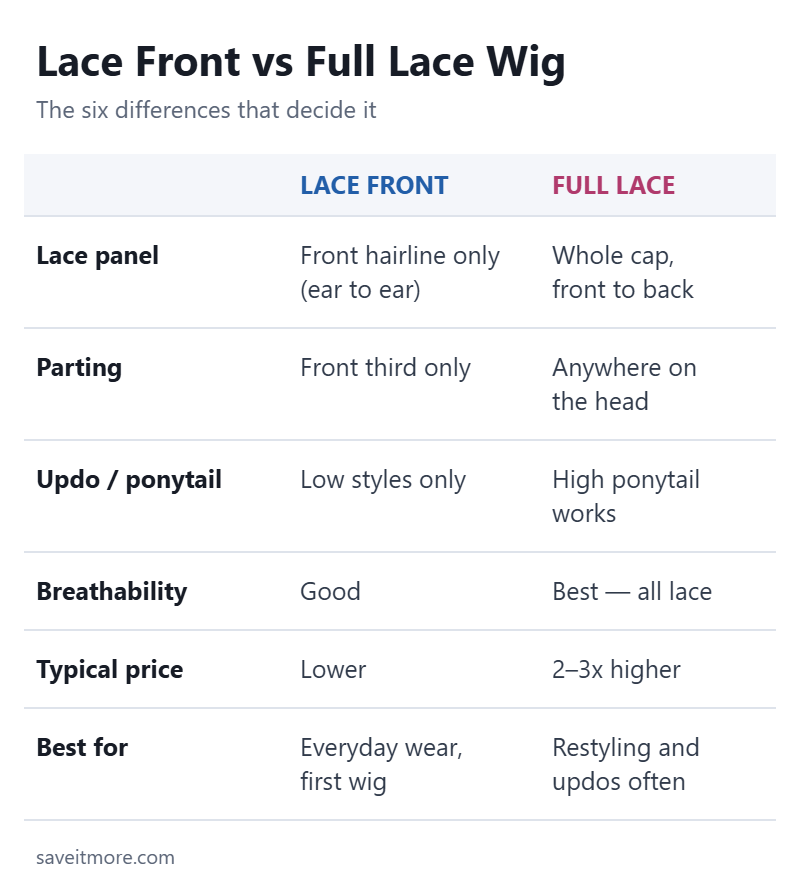
A lace front wig has a strip of sheer lace across the front hairline only, roughly ear to ear. Behind that strip, the cap is machine-stitched wefts. A full lace wig is built on lace across the whole cap, front to back, with every strand hand-tied into the mesh.
That one construction difference drives the price gap, the styling freedom and the comfort difference. This chart sums it up:
1. Where the lace actually sits
On a lace front, the lace panel is usually two to six inches deep and runs across the forehead. Behind it, the cap is stitched wefts — strong, quick to make and much cheaper to produce. That is why a lace front looks flawless from the front and solid from the crown.
On a full lace wig there is no weft at all. The whole cap is lace, so the scalp appears to show through wherever you separate the hair. It is the reason full lace units photograph convincingly from every angle, and the reason they take far longer to make. A skilled ventilator can spend days knotting a single cap.
Deep-part and 13×6 lace fronts sit between the two. They give you a bigger lace panel than a standard 13×4 front without the cost of an all-lace cap, and for a lot of buyers they are the sweet spot.
2. Parting and styling freedom
This is the difference most first-time buyers underestimate. With a lace front you can part anywhere inside that front panel — middle, side, a deep side part — but once you move past the lace you hit wefts, and the parting stops looking like scalp.
A full lace wig parts anywhere. Down the middle, on the far side, into two sections, or into a centre part that runs all the way to the nape. If you restyle often, or you like changing your part with your outfit, that freedom is the whole reason to pay more.
There is a practical test here. Look at photos of yourself from the last few months. If your part is in the same place in nearly all of them, a lace front will not hold you back.
3. Ponytails, buns and updos
A lace front handles a low ponytail or a half-up style without a problem. Pull it higher and the weft line at the back becomes visible. A full lace wig can be pulled into a high ponytail, a bun or a braided updo, because there is lace — not weft — at the nape and the crown.
If updos are a weekly thing for you, this single point is usually enough to settle the decision on its own. If they are a twice-a-year thing, it is not worth the premium.
4. Knots, bleaching and how natural it looks
Each strand on a lace cap is knotted into the mesh, and those knots show as tiny dark dots. Sellers bleach the knots at the hairline to lighten them. On a lace front, only the front knots need that attention. On a full lace wig the knots sit across the whole cap, so the quality of the knotting matters far more — and so does how gently you comb it.
Two details are worth checking on any listing. The first is knot type: single knots at the perimeter look finer and more scalp-like than double knots. The second is the lace itself. HD or Swiss lace is thinner and melts into more skin tones than standard transparent lace, on either cap type.
When you are comparing sellers, the honest signals are close-up hairline photos, real buyer images rather than studio shots, and a clear return policy. Our guide to the most trustworthy product review sites covers how to tell a genuine review from a planted one before you spend.
5. Comfort and breathability

All-lace caps breathe better than wefted ones, which is a real advantage in hot weather or if you wear a unit for long days. A lace front is still comfortable — the wefted section is light — but it traps more heat than a full lace wig does.
Comfort is also about tension. Adhesives, tight elastic bands and heavy, high-density units all pull on your own hairline, and repeated pulling is a recognised cause of hair loss. The American Academy of Dermatology explains how hairstyles that pull can lead to hair loss, and has separate advice on preventing hair damage from weaves and extensions. Take the unit off at night, and loosen anything that leaves your scalp sore the next morning.
6. Price: what the extra lace costs you
Hand-tying an entire cap takes far more labour than stitching wefts, so a full lace wig typically sells for two to three times the price of a comparable lace front in the same hair grade, density and length. Two units with identical hair can sit at very different prices purely because of the cap underneath.
Put it another way: for the price of one full lace wig you can often buy two lace fronts. If you want variety more than you want parting freedom, that arithmetic matters more than any feature list.
Density is the other lever on price. A 150% density unit costs less than a 250% one and looks more like real growing hair, so do not assume the most expensive spec is the most natural-looking one.
So which lace wig should you buy?
Buy a lace front if this is your first wig, you wear your hair down most days, you part in the same place, or the budget is the deciding factor. It gives you a realistic hairline — the part everyone actually looks at — without paying for lace you will never part through.
Buy a full lace wig if you restyle frequently, wear high ponytails or updos, want to move your part freely, or need maximum breathability for long wear. It is a bigger outlay and it needs gentler handling, but nothing else gives you the same freedom.
Whichever cap you pick, the fit is decided by your measurements, not by the cap type. Take five minutes to measure your head for a wig before you order — an “average” cap is not average for everyone, and a loose cap ruins an expensive unit.
Human hair or synthetic?
Cap type and fibre are separate decisions, and both lace fronts and full lace units come in each. Human hair takes heat, colour and restyling, and lasts longest with care. Synthetic holds its style through rain and washing but cannot be heat-styled unless it is sold as heat-friendly.
If you are spending on a full lace wig, human hair is usually the sensible pairing — you are buying styling freedom, and synthetic fibre limits exactly that.
How long each one lasts
Longevity comes down to hair quality and handling more than cap type, but there is a pattern. A wefted lace front cap is more robust, so it survives rough handling better. A full lace wig is more delicate at the knots and parting area, which is why an expensive unit can wear out faster than a cheap one in careless hands.
- Detangle from the ends upwards with a wide-tooth comb, never from the roots down.
- Wash in cool water with sulphate-free shampoo, and never wring or twist the lace.
- Air-dry on a wig stand so the cap keeps its shape.
- Keep heat tools low and always use a heat protectant — wig hair cannot repair itself.
- Store it on a stand or in its box, not crushed in a drawer.
- Remove adhesive properly rather than pulling, and give your own hairline rest days.
How to pay less for a lace front or full lace wig
Hair sites discount heavily and often, which means paying full price is usually a mistake. A few habits that work:
- Check the store page before you check out. We track live offers for hair retailers including UNice, whose lace front and full lace wig ranges are among the most frequently discounted on the market.
- Buy two units in one order. Bundle and “buy more, save more” tiers usually beat a single-unit code.
- Sign up for the email list first. A new-customer code is often the biggest single discount a hair site offers.
- Do not stack blindly. Most hair stores allow one code per order, so take the larger of the two rather than losing a sitewide sale.
- Check the code is real. Our guide to finding verified coupon codes for your favourite stores shows where working codes actually come from.
Frequently asked questions
Is a full lace wig worth the extra money?
A full lace wig is worth it if you will genuinely use the parting and updo freedom. If you wear your hair down with the same part every day, that money is better spent on hair quality, or on a second unit.
Which looks more natural, lace front or full lace?
From the front, a well-made lace front looks just as natural as full lace — both use the same sheer lace at the hairline. A full lace wig wins from the back, the crown and in updos.
Can you wear a lace front in a ponytail?
A low ponytail or a half-up style, yes. A high ponytail exposes the wefted section at the back, so that is full lace territory.
Which one is cooler to wear in hot weather?
Full lace, because the whole cap is mesh. A lace front is still wearable in heat, but the wefted area holds more warmth.
Do both need glue?
No. Many lace fronts and full lace units come with adjustable straps and combs and can be worn glueless. Adhesive gives a flatter hairline, but it is optional — and going glueless is kinder to your own edges.
What is a 360 lace wig?
A 360 lace wig has lace running all the way around the perimeter with a wefted section on top. It sits between the two: you get a low or mid ponytail and a natural edge all round, but not the free parting of a full lace wig.
The bottom line
In the lace front vs full lace wig decision, you are really buying styling freedom rather than realism. Both give you a convincing hairline. Only a full lace wig gives you a convincing parting anywhere on your head — and it charges two to three times as much for it. Be honest about how you actually wear your hair, measure your head properly, and buy the cap that matches your routine rather than the one with the bigger price tag.