



If you want to measure your head for a wig, you need a soft tape measure, a mirror and about five minutes. It is the single step that decides whether a wig sits flat and natural or slides back, pinches at the temples and gives you a headache by lunchtime.
Most wigs are sold in one “average” cap size, and most people buy that size without checking. It works for a lot of heads, but not for all of them. This guide shows you the four measurements that matter, how to read a cap size chart, and what to do if you land between two sizes.
The short answer
To measure your head for a wig, wrap a soft tape around your head, starting at the front hairline, passing just above the ears and around the nape of the neck at the back. That number is your head circumference, and it is the one measurement that decides your cap size. Around 21.25 to 22.5 inches (54 to 57 cm) is an average cap. Smaller is petite; larger is a large cap.
The other three measurements help with fit and adjustment, and they matter more for lace front and custom wigs than for ready-to-wear styles.
What you need before you measure your head for a wig
- A soft, flexible tape measure — the fabric kind used for sewing. A metal DIY tape will not follow the curve of your head.
- A mirror, or better, someone to help. The back measurements are much easier with a second pair of hands.
- A pen and paper to note each number as you go.
- Your hair prepared the way you will wear it under the wig. This is the step most people skip.
That last point is important when you measure your head for a wig. If you will wear your own hair braided or in a flat wrap under a wig cap, braid or wrap it first and measure over the top. Measuring over loose hair and then wearing the wig over cornrows is one of the most common reasons a wig feels tight. If you have little or no hair, measure directly over the scalp.
No tape measure? You can still measure your head for a wig using a piece of string or a phone charging cable, mark where it meets, then lay it flat against a ruler. It is slightly less precise, but it is close enough to choose a cap size.
How to measure your head for a wig: four measurements
Every time you measure your head for a wig, take each measurement twice. If the two readings differ, take a third and use the number that appears most often. Keep the tape snug against the head, flat rather than twisted, and never pulled tight.
1. Head circumference
This is the main one, and the first number to take when you measure your head for a wig. Place the start of the tape at the centre of your front hairline. Run it around the side of your head, just above the tip of the ear, down to the nape of your neck at the back where your hair stops growing, then up the other side above the other ear and back to where you started.
The tape should sit where the edge of the wig will sit. Too high and the reading is small; too low and it is large. Write the number down in inches or centimetres — whichever the brand’s chart uses.
2. Front to nape
Start at the centre of the front hairline and run the tape straight back over the crown of your head to the nape of the neck. This tells you how deep the cap needs to be from front to back. If it is too short, the wig tends to slide backwards during the day.
3. Ear to ear across the top
Start at the hairline just in front of one ear, go straight up over the top of your head and down to the same point in front of the other ear. This confirms the cap is wide enough at the sides without gaping.
4. Temple to temple around the back
Start at one temple, go around the back of the head at the widest part — roughly the occipital bone, the bump at the back of the skull — and finish at the other temple. This measurement matters most for how securely the wig grips at the back.
Wig cap size chart
Once you measure your head for a wig and have your circumference, read across this chart. Front-to-nape and ear-to-ear figures vary more from brand to brand, so treat those as a check rather than the deciding number.
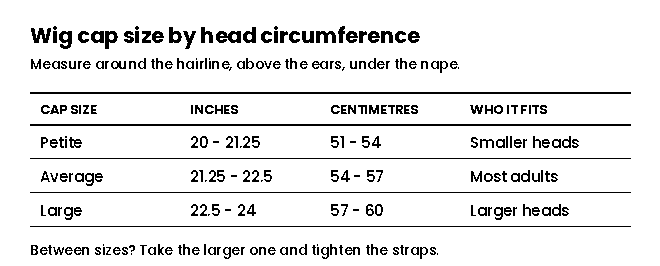
- Petite: about 20 to 21.25 inches (51 to 54 cm)
- Average: about 21.25 to 22.5 inches (54 to 57 cm)
- Large: about 22.5 to 24 inches (57 to 60 cm)
Most adults fall into the average range, which is why it is the default size on most wig listings. Always check the specific brand’s own chart before you order, because the boundaries can shift by a quarter or half inch between manufacturers.
Between two sizes after you measure your head for a wig?
Most wigs have adjustable straps at the back of the cap, usually with hooks or velcro that tighten the fit by around half an inch to an inch. That makes the decision easier:
- If you are right on the line, choose the larger size. Straps can tighten a cap. Nothing can make a small cap bigger.
- If you are only slightly over petite, an average cap with the straps pulled in is usually the most comfortable option.
- If you are above the large range, look for brands that sell extra-large caps or offer custom sizing rather than forcing a large cap to fit.
Wig grips and elastic bands are another way to fine-tune a cap that is slightly loose. They hold the wig in place without glue and reduce slipping.
Five mistakes to avoid when you measure your head for a wig
Pulling the tape too tight. It should rest flat against the head with no gap, not dig in. A tight reading leads to a tight wig, which is where headaches and tension at the hairline come from.
Measuring over loose hair you will not wear loose. Measure over the style you will actually wear underneath — braids, a flat wrap, or bare scalp.
Running the tape over the ears. The tape goes just above the ears, following the hairline. Going over the top of the ear adds length and gives you a cap that sits too low.
Missing the nape. The tape has to dip to the nape of the neck at the back. Running it across the middle of the back of the head gives a smaller number than your real size.
Measuring once. A single reading is easy to get slightly wrong. Two or three readings take an extra minute and settle any doubt.
Cap construction matters as much as size
When you measure your head for a wig, the number tells you the size — but the cap construction decides how that size feels. A few terms you will see on product pages:
- Lace front — a sheer lace strip along the front hairline for a natural look. Fit at the front matters here, so your front-to-nape and ear-to-ear numbers are worth checking.
- Full lace — lace across the whole cap. Most flexible for styling, and usually the most forgiving on fit. Our lace front vs full lace wig comparison covers which cap is worth the extra money.
- Glueless — held on with combs, straps and an elastic band rather than adhesive. Accurate circumference matters more because there is no glue to compensate.
- Basic or capless — open wefts with good airflow. These stretch more and forgive a small sizing error.
Buying your wig
Once you measure your head for a wig and have your four numbers written down, you can compare product listings properly instead of guessing. Check the cap size, the cap type, and whether the straps are adjustable. Then check the brand’s return policy on worn or unworn wigs before ordering, because it varies a lot.
If you are looking at human hair lace front or glueless wigs, our Ashimary Hair coupon codes page lists the store’s current offers. Read the terms on any code first — some apply only to specific lengths or collections, and a free-shipping threshold can be worth more than a small percentage off.
If you are measuring for other things at the same time, our guides on how to measure yourself for a dress and how to measure your foot size at home use the same tape and the same careful approach.
Frequently asked questions
What is the average wig cap size?
An average cap fits a head circumference of about 21.25 to 22.5 inches, or 54 to 57 cm. Most wigs are sold in this size by default, and adjustable straps let it fit a range of heads.
Do I measure my head with or without my hair?
Measure your head for a wig over whatever you will wear under it. If you wear braids or a flat wrap, measure over them. If you wear the wig directly on the scalp, measure over the scalp.
Can I measure my head for a wig without a tape measure?
Yes. Use string, ribbon or a charging cable, pinch or mark where it meets, then measure it flat against a ruler. It is less precise than a soft tape but good enough to choose between petite, average and large.
What if my wig is too big?
Tighten the adjustable straps first. If it is still loose, a wig grip band or a few sewn-in combs usually solve it. A stylist can also take in the cap by adding a small tuck at the back.
What if my wig is too tight?
A tight wig cannot be stretched much. Loosen the straps fully and see if that helps; if not, exchange it for the next cap size up. Wearing a tight wig for long periods puts pressure on your natural hairline.
How often should I re-measure?
Measure your head for a wig again whenever you change what you wear underneath — for example, switching from a flat wrap to braids — or if your natural hair has grown significantly since your last wig.
The bottom line
To measure your head for a wig properly, take the circumference over the hairstyle you will wear underneath, keep the tape flat and snug, and follow the hairline just above the ears and down to the nape. Add the three supporting measurements if you are buying a lace front or glueless wig.
If you land between sizes, go up and use the straps. It takes five minutes, and it is the difference between a wig you forget you are wearing and one you cannot wait to take off.
Cap size ranges in this guide follow standard industry sizing as described in the Simply Wigs wig size guide. Always confirm with the chart of the brand you are buying from, since sizes vary slightly.