


A portable power station in cold weather still works — but not quite like it does in summer. Freezing temperatures slow the battery down, cut your runtime and can stop it charging altogether. If you rely on a power station for winter power cuts, ice fishing, cabin trips or a van, a few simple habits keep it working when you need it most and protect the battery for years.
This guide explains what cold does to the battery, the safe way to charge and store it, how to use it outdoors, and which features matter if you live somewhere with real winters, such as most of Canada.
What cold does to a power station battery
Inside the battery, lithium ions move more slowly as the temperature drops. According to EcoFlow’s cold-weather guide, that means:
- Shorter runtime — the battery drains faster than usual.
- Slower or blocked charging — many units reduce or refuse charging when they are too cold.
- Automatic shutdowns — the battery management system may switch off to protect itself.
The good news: this loss is usually temporary. Once the battery warms up, performance returns to normal. Heat, not cold, causes most permanent battery damage.
The one rule: never charge a frozen battery
The biggest risk with a portable power station in cold weather is charging it while the battery is below freezing. Charging lithium batteries at low temperatures can cause lithium plating, an irreversible process that permanently reduces capacity. Battery maker RELiON notes that LiFePO4 batteries charged below 0°C (32°F) need a much lower charge current to stay safe.
Most modern power stations have protection built in and will slow or stop charging when too cold — but the safest habit is simple: bring the unit indoors and let it warm to room temperature before plugging it in or connecting solar.
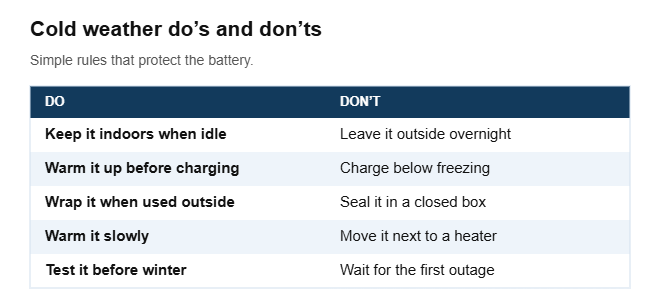
Cold weather do’s and don’ts
How to store a portable power station in cold weather
- Store it indoors in a heated space — a closet, basement or utility room — not a cold garage, shed or car.
- Keep it partly charged. Most manufacturers recommend storing lithium batteries at a partial charge (often around half to three-quarters) rather than full or empty, and topping up every few months.
- Top it up before storm season. A winter storm is the worst time to discover the battery is flat.
- Avoid heat sources. Do not store it right next to a heater, furnace or fireplace — too much heat is worse than cold.
Using a portable power station outdoors in the cold
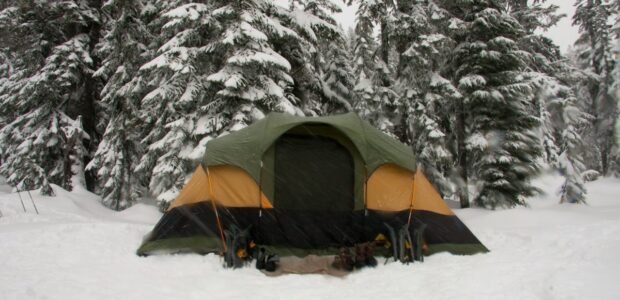
Sometimes a portable power station in cold weather has to sit outside — at a campsite, an ice-fishing hut or a job site. To get the most from it:
- Warm it indoors first. Start the day with a warm, fully charged unit.
- Insulate it. Wrap it in a blanket or place it in an insulated cooler with the lid slightly open — but never block the cooling vents while it is running, and never seal it airtight.
- Keep it off the ground. Snow and frozen ground pull heat away fast. Put it on a board, box or foam pad.
- Keep it dry. Snow and meltwater can get into ports. Use a cover designed for your model where possible.
- Expect less runtime. Plan for a noticeably shorter runtime than the spec sheet suggests, and prioritise essential devices.
Warming up a portable power station in cold weather
When you bring a portable power station in from cold weather, let it warm up gradually at room temperature. Rapid temperature changes — for example, putting it straight next to a heater — can cause condensation inside the unit. Wait until it feels room temperature before charging. If it has shut down in the cold, bring it inside, wrap it and wait before trying again.
Best features for a portable power station in cold weather
- LiFePO4 (lithium iron phosphate) battery — longer life and better tolerance than older lithium chemistries.
- Battery self-heating — some premium models warm their own battery before charging in the cold, which is a real advantage for Canadian winters.
- Clear operating and charging temperature ranges — check both on the spec sheet; they are usually different.
- Enough capacity for winter loads — furnace fans, sump pumps, lights, a fridge and internet. Our guide on what size portable power station you need helps you size it.
- Solar input — useful for longer outages, though winter sun is weaker and days are shorter. Our guide to choosing a solar panel for a portable power station covers the input-voltage window to check first.
Buying in Canada: how to save
If you need a portable power station in cold weather for winter power cuts in Canada, EcoFlow’s Canadian store sells its RIVER and DELTA ranges, including larger models suited to home backup, and runs frequent sales on them.
Check current EcoFlow Canada offers
A portable power station for cold weather is a big purchase, and and discounts on larger models can be substantial. Compare the sale price with any code before you order.
See EcoFlow CA coupon codes → · Outside Canada: ALLPOWERS codes →
Heading out to camp in the cold? Our camping gift ideas include warm layers and solar panels that pair well with a power station.
Frequently asked questions
Can you use a portable power station in cold weather?
Yes. Power stations work below freezing, but with shorter runtime and possible automatic shutdowns. Keeping the unit warm and insulated helps a lot.
Can I charge my power station outside in winter?
Only if the battery is above freezing or the unit has built-in battery heating. Otherwise, bring it indoors and let it warm up before charging.
Does cold weather damage a power station?
Using it in the cold mostly causes temporary performance loss. Charging a frozen battery, however, can cause lasting damage.
Can I leave a power station in my car in winter?
It is best not to. A car gets very cold overnight, which drains the battery and makes charging unsafe until it warms up.
What is the best battery type for cold climates?
LiFePO4 batteries are generally the best choice, especially in models with built-in self-heating for charging in freezing conditions.
The bottom line
A portable power station in cold weather is perfectly usable if you respect the battery: store it indoors, never charge it while frozen, warm it gradually, insulate it outside and plan for shorter runtime. If you live somewhere with hard winters, choose a LiFePO4 model — ideally with self-heating — and check the current offers before you buy.