


If you are asking what size portable power station do I need, the honest answer is that it depends on two numbers, not one — and most people only look at the first. Get both right and the choice is straightforward. Get one wrong and you end up with a unit that either runs out too soon or refuses to start your fridge at all.
This guide gives you the formula, a table of realistic appliance draws, and the four mistakes that account for almost every disappointed review in this category.
The two numbers that matter
Before anything else, these two specifications do completely different jobs and are easy to confuse.
Capacity, measured in watt-hours (Wh). This is how much energy the battery holds — in other words, how long it can run things. A 1000Wh unit can theoretically deliver 100 watts for ten hours, or 500 watts for two.
Output, measured in watts (W). This is how much the inverter can deliver at once — in other words, what it can run. A unit rated at 600W continuous cannot run a 1500W kettle no matter how enormous its battery is.
People shop on watt-hours because it is the bigger, more impressive number. Then they plug in a microwave and the unit shuts off. Both numbers have to clear your requirement.
What size portable power station do I need? The formula
Four steps, and you only need a phone calculator.
Step 1 — List what you actually need to run
Not everything you own. Write down only the things that genuinely need power during an outage, a camping trip or a work session — and be honest about which of them can simply wait.
For most people the real list is short: phone, laptop, router, some lights, maybe a fridge or a CPAP machine.
Step 2 — Find the watts for each
Check the label on the device or its power brick. It will show watts directly, or volts and amps — multiply those together to get watts.
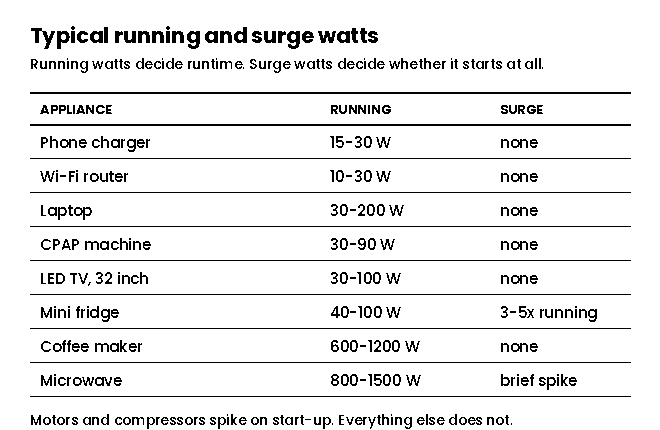
Use the table below where you cannot find a label. It gives realistic ranges rather than best-case figures.
Step 3 — Multiply by hours, then add it all up
For each device: watts × hours of use = watt-hours.
A 60W laptop for 5 hours is 300Wh. A 15W router for 24 hours is 360Wh. A 10W bulb for 6 hours is 60Wh. Add them together for your raw total.
Step 4 — Divide by 0.85
This is the step nearly everyone skips, and it is why so many people find their unit falls short.
Converting stored DC battery power into the AC electricity your appliances use is not free — the inverter loses some of it as heat. Around 15% is a reasonable planning figure.
So: required capacity = your total Wh ÷ 0.85.
A raw total of 720Wh becomes roughly 850Wh of real capacity needed. Round up from there, not down.
Now check the output watts
Capacity tells you how long. Output tells you whether it will run at all.
Add up the running watts of everything you might have plugged in at the same time, then add about 20% headroom. That figure has to be within the unit’s continuous output rating.
Then there is surge. Anything with a motor or compressor — a fridge, a pump, a power tool — draws far more for the first second or two than it does while running. A fridge that runs at 80W can spike to several hundred watts on start-up. If the inverter cannot supply that spike, the unit trips and the fridge never starts, however full the battery is.
Manufacturers publish a separate surge or peak rating for exactly this. Check it against the highest surge on your list, not the average.
Resistive appliances — kettles, heaters, toasters, hair dryers — have no meaningful surge, but their running draw is enormous. A 1500W kettle needs a 1500W-plus inverter from the moment it switches on.
Rough sizes for common jobs
Once you have run the numbers, these bands give you a sanity check.
Under 300Wh. Phones, tablets, a camera, a small light. Genuinely portable, fits in a bag. Will not run anything with a heating element.
300 to 700Wh. A laptop for a working day, router, lights, a CPAP overnight. The most common choice for camping and light backup. Still carryable one-handed.
700 to 1500Wh. The above plus a fridge for several hours, or occasional use of a kettle or microwave. This is the usual band for meaningful home backup during a power cut. Heavy enough that you carry it with two hands.
1500Wh and up. Running a fridge for a full day, power tools, or several rooms at once. Often expandable with extra battery packs. Realistically these live in one place rather than travelling.
A note on that home-backup use case: a portable power station is not a whole-house generator, and it is not wired into your consumer unit. If you are still weighing the two approaches, our comparison of a portable power station vs generator covers the safety rule that usually settles it. It powers what you plug into it, one appliance at a time. For most households that is enough to keep the fridge cold and the phones charged — which is usually what actually matters.
Four sizing mistakes
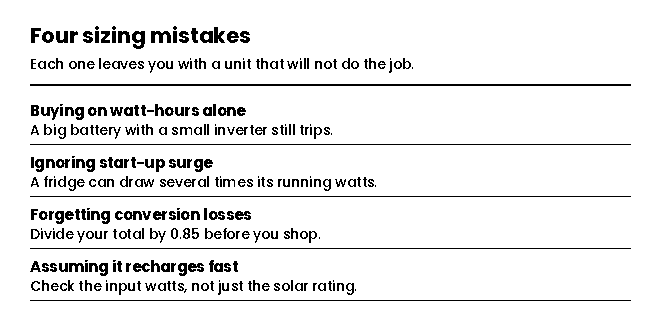
Buying on watt-hours alone. The headline number sells units, but a large battery behind a small inverter still cuts out under load. Check both specifications every time.
Ignoring start-up surge. This is the one that produces angry reviews. The fridge never starts, the unit looks faulty, and nothing is actually wrong except the sizing.
Forgetting conversion losses. Buying exactly the watt-hours you calculated leaves you roughly 15% short in practice. Divide by 0.85 first.
Assuming it recharges quickly. A big battery with a slow charger is frustrating. Check the AC input watts — the difference between a unit that refills in ninety minutes and one that takes eight hours is the input rating, not the battery size. The same applies to solar: the panel’s rating is a ceiling, and real output in typical conditions is a good deal lower — our guide to picking a solar panel for a portable power station explains how much of the rated figure you actually get.
Battery chemistry is worth one minute of your time
Two types dominate, and the difference matters more than most spec sheets suggest.
LiFePO4 (lithium iron phosphate) typically lasts around 3,000 cycles or more before dropping to 80% of its original capacity, tolerates heat better, and is the safer chemistry. Neither chemistry enjoys the cold, though, and most will not accept a charge below freezing at all — see using a portable power station in cold weather for what that does to usable capacity. It is heavier for the same capacity, and usually costs more up front.
NMC (lithium nickel manganese cobalt) is lighter and cheaper but generally rated for fewer cycles — often in the 500 to 1,000 range.
If you will use the unit weekly, LiFePO4 is almost always the better value over its life despite the higher purchase price. If it will sit in a cupboard for the occasional power cut, NMC is a reasonable saving. Cycle life is published by every serious manufacturer; if a listing does not mention it, treat that as informative.
Keeping the cost down
Power stations are expensive enough that getting the size right is itself the biggest saving — an undersized unit gets replaced, and an oversized one is money spent on capacity you never use.
Beyond that, two things are worth checking before you order. First, whether a solar panel is genuinely bundled or merely “compatible”, since panels are a substantial extra cost. Second, whether the model is being discounted, because this category runs promotions frequently. Our ALLPOWERS coupon codes page lists the current offers on power stations and solar panels.
One honest note on shopping this category: model-specific codes often beat sitewide percentages by a wide margin, so check whether there is an offer attached to the exact unit you want before applying a general one. And read the warranty length — for a product built around a battery, that number tells you something about the manufacturer’s own confidence.
Frequently asked questions
What size portable power station do I need to run a fridge?
For a full day you generally want 1000Wh or more, with an inverter that can handle the compressor’s start-up surge. Fridges cycle on and off rather than running continuously, so actual consumption is lower than the running watts suggest — but the surge requirement is fixed.
How long will a 1000Wh power station last?
Divide 1000 by the watts you are drawing, then subtract roughly 15% for conversion losses. At 100W that is around eight and a half hours; at 500W, closer to one hour forty.
Can a portable power station run an air conditioner?
A small portable unit, sometimes, with a large power station. A fixed or central system, no. Air conditioning has both a high running draw and a significant start-up surge, so it is the hardest common appliance to power this way.
Can I charge it while using it?
Most models support pass-through charging, but check your specific unit rather than assuming. Some manufacturers advise against it for extended periods because of the heat it generates.
Is a bigger one always better?
No. Larger units are heavier, more expensive, and slower to recharge. If a unit is too heavy to move, its portability is theoretical. Size to your actual list plus sensible headroom, not to the maximum you can afford.
How long do these last before the battery degrades?
Rated in charge cycles rather than years. LiFePO4 units are commonly rated around 3,000+ cycles to 80% capacity; NMC units often 500 to 1,000. For occasional use that is many years either way.
The bottom line
Answering what size portable power station do I need comes down to four steps: list what you will actually run, multiply watts by hours, divide the total by 0.85, and then separately check that the output and surge ratings clear your biggest appliance.
Do those four things and you will buy once. Skip the surge check or the 0.85, and you will either return it or replace it — which is considerably more expensive than getting the sums right in the first place.
The sizing formula and appliance figures above follow standard industry guidance as published by Outbound Power. Individual appliances vary — where you can read the label on your own device, use that figure instead.