

Knowing how to measure yourself for a dress matters more than knowing your dress size, because for anything made to order — a bridesmaid dress, a bridal gown, a formal dress from an online retailer — the size you normally buy is close to irrelevant. What the maker works from is four numbers.
This guide covers exactly where each of those four measurements is taken, the things that quietly throw them off, and how to decide what to order when your numbers land across two different sizes. It takes about ten minutes and it is the difference between a dress that needs a small alteration and one that needs a rescue.
Before you start
Three things make a real difference to how accurately you can measure yourself for a dress:
- Use a soft fabric tape measure, not a builder’s retractable one. A metal tape cannot follow the curve of a body and will read short.
- Wear thin, close-fitting underwear — ideally the bra you intend to wear with the dress, because a different bra genuinely changes the bust measurement.
- Ask someone to help. Measuring your own back, and your own hollow-to-hem, involves twisting and looking down, both of which shift the numbers. If you are alone, a mirror helps but a second person helps more.
Stand naturally throughout — feet together, arms relaxed at your sides, breathing normally. Holding your breath or standing to attention gives you numbers that belong to a different body than the one that will wear the dress.
How to measure yourself for a dress: the four measurements
1. Bust
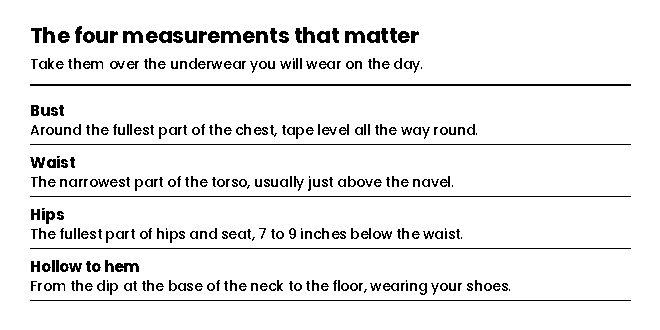
Run the tape around the fullest part of your chest, across the nipple line, and back around under your shoulder blades. The critical part is that the tape stays level all the way round — it is very easy for it to ride up at the back without you noticing.
The tape should lie flat against you, snug but not compressing. If it is leaving a mark, it is too tight.
Note that this is your bust measurement, not your bra size. They are different numbers and makers want this one.
2. Waist
Your natural waist is the narrowest part of your torso, which for most people sits a couple of inches above the navel — noticeably higher than where jeans sit.
The easiest way to find it: bend sideways. The crease that forms is your natural waist. Measure there, with the tape level.
If you cannot see an obvious narrowest point, use the midpoint between the bottom of your ribcage and the top of your hip bone.
3. Hips
Measure around the fullest part of your hips and seat, which is usually seven to nine inches below your natural waist. Stand with your feet together — standing with feet apart widens the measurement.
Take it from the side in a mirror if you can, to check the tape is level front to back rather than dipping.
4. Hollow to hem
This is the one people skip, and it is the one that decides whether the dress is the right length.
The “hollow” is the small dip at the base of your throat, between your collarbones. Measure from there straight down the front of your body to the floor.
Wear the shoes you plan to wear with the dress, or at least the same heel height. A three-inch heel changes this measurement by three inches, and hem length is not something you want to guess.
Stand up straight and look forward, not down — looking down shortens the reading. This is the measurement most worth having someone else take.
Four things that quietly ruin a fitting
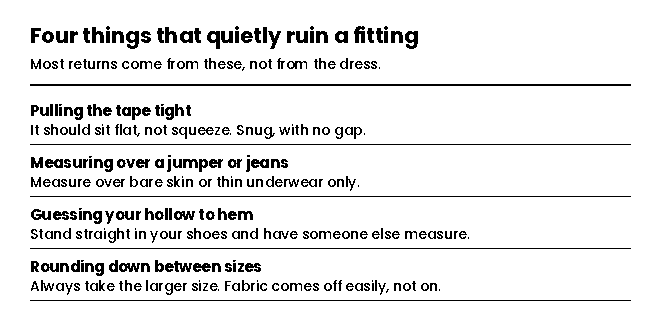
Pulling the tape tight. The instinct is to pull for a “true” number, but a compressed measurement produces a dress you cannot breathe in. The tape should sit flat with no slack and no squeeze — you should be able to slide a finger under it with mild resistance.
Measuring over clothes. Even a thin jumper adds a centimetre or more, and jeans at the waist add several. Measure over bare skin or thin underwear only.
Guessing the hollow to hem. Either because no one was around to help, or because the shoes had not been chosen yet. Both lead to a hem that is wrong by inches. If you genuinely do not have the shoes yet, decide on a heel height and measure to that, then tell the maker what you assumed.
Rounding down. Always round up to the nearest half centimetre or quarter inch, and always take the larger size when you are between two. A seamstress can take fabric in easily. Letting it out depends entirely on how much seam allowance the dress was made with, and often there is not enough.
Why bridal and formal sizing runs small
This catches almost everyone the first time, and it is worth knowing before you see the number rather than after.
Bridal and formal sizing typically runs one to two sizes smaller than the high street sizing you are used to. Someone who buys a 10 in everyday clothes will often need a 12 or 14 in a bridal size chart.
The reason is historical rather than sinister — bridal size charts were set decades ago and have not shifted the way ready-to-wear sizing has. It is not a comment on you, and it is not worth a moment’s thought.
The practical consequence is simple: ignore the size number entirely and order from your measurements. Put your four numbers against the specific chart for the specific dress, every time. Size charts vary between brands and sometimes between collections from the same brand.
What to do when your measurements span two sizes
This is extremely common and is not a problem — very few bodies match a single column of a size chart exactly.
The rule is: order the size that fits your largest measurement, then have the rest taken in.
Which measurement should drive the decision depends on the dress:
- Fitted bodice, full skirt — the bust and waist decide it. The skirt has room built in.
- Sheath, column or mermaid — the hips usually decide it, because those styles have the least ease through the seat.
- A-line — the bust, generally the most forgiving overall shape.
- Anything strapless — the bust, and be honest about it. A strapless bodice that is too big does not stay up, and that is not fixable by tightening a strap that does not exist.
Some retailers offer custom sizing, where the dress is cut to your exact four numbers rather than to a standard size. It usually costs a little more and adds time, but it removes most of the alteration bill, so it is worth comparing the two totals rather than just the two prices.
Leave time for alterations
Almost every formal dress needs some alteration — even a well-chosen size. Hems in particular are nearly always adjusted, because standard lengths are cut for a standard height that few people actually are.
Allow six to eight weeks between the dress arriving and the day you need it, and more if the dress is heavily beaded or has a complicated lining. Beading has to be removed and reapplied by hand along any seam that is altered, which is slow and adds cost.
Book the fitting early. Good alteration specialists get busy well ahead of peak wedding season, and a rushed hem is visible from across a room.
One more practical point: if you expect your body to change before the event, get measured as late as you sensibly can, and tell the seamstress. It is far easier to plan a final fitting a fortnight before than to guess at three months out.
Measuring for someone else
If you are the one holding the tape — for a bridesmaid, a daughter, a friend — a few things make it go better.
Tell them what you are doing before each measurement, and keep the tape level rather than conversational. Write each number down immediately; four numbers is exactly enough to misremember.
Do not read the numbers aloud unless they ask. Plenty of people find this part of dress shopping uncomfortable, and the number itself is meaningless out of context anyway — especially given how bridal sizing runs.
And measure everyone with the same tape. Two different tapes, particularly an old stretched one, can disagree by a centimetre.
Keeping the cost sensible
Taking the time to measure yourself for a dress properly is itself a cost-saving exercise. A dress ordered from accurate numbers needs a hem and maybe a small take-in. A dress ordered from a guessed size can need the bodice rebuilt, which is where alteration bills get genuinely expensive.
Beyond that, it is worth checking for a live offer before you order, since formal and bridal retailers run promotions almost constantly. Our AW Bridal coupon codes page lists the current offers for one of the larger online bridal and bridesmaid retailers.
Two honest notes on shopping this category. First, the biggest headline percentage is often not the best saving — sitewide codes with a low percentage frequently beat a larger code that excludes the entire bridal range. Second, factor the alteration budget in from the start rather than treating it as a surprise; it is a normal part of buying a formal dress, not a sign that something went wrong.
If you are planning a wedding rather than just an event, our guide to measuring your foot size at home is worth five minutes too — shoes bought online for a wedding day are returned at roughly the same rate as dresses, and for the same reason.
Frequently asked questions
What size dress should I order if I am between two sizes?
The larger one, every time. Taking a dress in is routine; letting it out depends on there being enough seam allowance, and often there is not.
Is my bust measurement the same as my bra size?
No. Bra sizing combines a band measurement and a cup letter; the bust measurement a dressmaker wants is a single number taken around the fullest part of your chest. Give them the number, not the bra size.
Do I really need the hollow-to-hem measurement?
For anything full-length, yes. It is what decides whether you get standard, petite or extra length, and getting it wrong means either a hem that drags or one that sits awkwardly short.
Is it possible to measure yourself for a dress with no help?
Bust, waist and hips are manageable alone with a mirror. Hollow-to-hem is genuinely difficult on your own, because looking down changes the reading. If you have to do it alone, stand against a wall, mark the floor and measure up.
How far in advance should I take my measurements?
Close to ordering, and then again before the final fitting. Measurements taken six months out are a reasonable starting point for ordering but should not be the ones a seamstress works from.
What if my dress arrives and it does not fit?
Check the retailer’s policy before you panic, and before you order — made-to-order and custom-sized dresses are frequently non-returnable, which is exactly why the measuring step matters so much. If it is too large, a seamstress can almost certainly fix it. If it is significantly too small, alteration options are much more limited.
The bottom line
The reliable way to measure yourself for a dress is to take four numbers carefully, over thin underwear, with a soft tape and someone helping — and then to trust those numbers rather than the size you usually buy.
Order to your largest measurement, round up rather than down, and leave six to eight weeks for alterations. Do that, and the dress that arrives needs adjusting rather than rescuing.
Ten minutes with a tape measure is the cheapest insurance in the whole process.
Measurement points and the guidance on bridal sizing above follow standard bridal-industry practice as published by David’s Bridal. Size charts vary between retailers and between collections — always measure against the chart for the specific dress you are ordering.