

Knowing how to measure yourself for a suit saves you from the most common suit-buying mistake: ordering by the size on your last jacket and hoping. Suits are cut in two dimensions — chest and height — and most men only know one of them. Get both right and an off-the-rack suit needs a hem and not much else.
This guide covers the six measurements, how to read a size like 40R, and the “drop” rule that decides whether the trousers in a suit set will actually fit you.
What you need to measure yourself for a suit
- A soft fabric tape measure — not a metal one from the toolbox.
- A thin, well-fitting dress shirt, or a T-shirt. No jumpers.
- Your usual dress shoes, for the trouser length.
- Someone to help. You can take most of these alone, but chest, shoulders and sleeve are far more accurate with a second person.
Before you measure yourself for a suit, empty your pockets, stand naturally, and breathe normally. Puffing your chest out or sucking your stomach in gives you numbers for a body you do not actually walk around in.
How to measure yourself for a suit: the six measurements
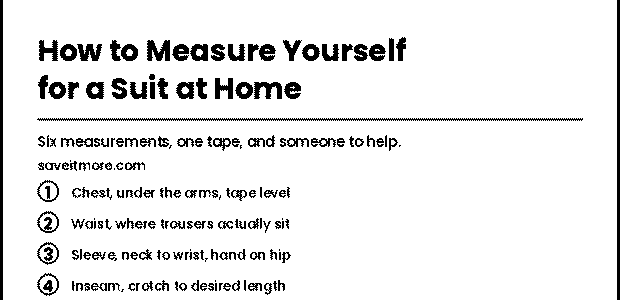
1. Chest
This is the one that decides your jacket size when you measure yourself for a suit.
Raise your arms slightly, wrap the tape under your armpits and around the fullest part of your chest and shoulder blades, then lower your arms. Keep the tape parallel to the floor all the way round — it tends to drop at the back if you are not watching.
The tape should be snug but not tight. You should be able to slide a flat hand underneath it. That number, in inches, is your jacket size: a 40-inch chest wears a size 40 jacket.
2. Shoulders
To measure yourself for a suit at the shoulders, go across the back from the bony point of one shoulder to the other, following the natural curve rather than pulling straight across. This measurement tells you whether a jacket’s shoulder seam will sit on your shoulder or hang past it.
Shoulders matter more than people expect because they are the one part of a jacket a tailor cannot realistically fix. A jacket that fits the shoulders and is loose elsewhere can be tailored. The reverse usually cannot.
3. Sleeve
Put your hand on your hip, so the elbow bends slightly. Measure from the centre back of your neck, over the top of the shoulder, down the arm to the wrist bone.
When you wear the suit, about half an inch of shirt cuff should show below the jacket sleeve. Sleeve length is one of the easiest alterations, so this measurement is useful but not critical.
4. Waist
This is your trouser waist, which is not the same as your jeans size. Measure where your suit trousers will actually sit — for most men that is around the navel, noticeably higher than jeans. Keep one finger between the tape and your body.
5. Seat
Stand with your feet together and measure around the fullest part of your seat. Useful for slim-cut trousers, where the seat is often the first place a size fails.
6. Inseam
Measure from the crotch seam down the inside of the leg to where you want the trousers to end. Wearing your dress shoes, most men prefer a “slight break” — the trouser just touches the top of the shoe with a single small fold.
The easiest way to get this right when you measure yourself for a suit: measure the inseam of a pair of trousers you already own that fit well. Lay them flat and measure crotch seam to hem.
How to read a suit size like 40R
Once you can measure yourself for a suit, the size label stops being a mystery. It has two parts.
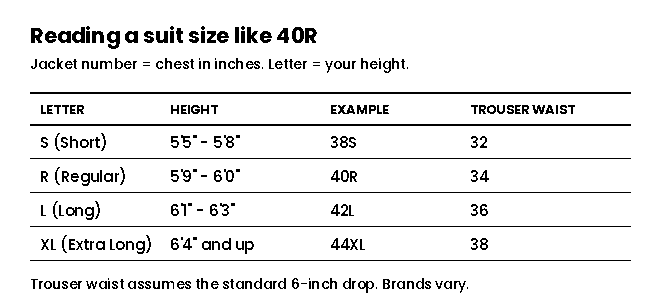
The number is your chest in inches. A 40 fits a 40-inch chest; a 42 fits a 42-inch chest.
The letter is your height. It controls the jacket’s length and the sleeve length:
- S (Short) — roughly 5’5″ to 5’8″
- R (Regular) — roughly 5’9″ to 6’0″
- L (Long) — roughly 6’1″ to 6’3″
- XL (Extra Long) — 6’4″ and up
So a man who is 5’10” with a 40-inch chest wears a 40R. A man who is 6’2″ with the same chest wears a 40L. Same chest, different jacket — and a 40R on the taller man will look noticeably short in the body and sleeves.
If you are right on the boundary between two height bands, let your arm length decide. Long arms push you towards the longer size.
The drop: why suit trousers sometimes do not fit
When a suit is sold as a set, the trousers come in a waist size tied to the jacket size. The gap between the two is called the drop.
The standard drop is 6 inches. A size 40 jacket comes with 34-inch trousers; a 42 comes with 36-inch trousers.
That works well for an average build and badly for anyone else. An athletic build with a broad chest and narrow waist often needs a bigger drop — a 42 jacket with 34 trousers. A man carrying more weight around the middle may need a smaller one.
If your chest and waist measurements do not sit roughly 6 inches apart, look for suits sold as separates, where you choose the jacket and trouser sizes independently. It costs nothing extra and solves the problem completely.
Fit: what a well-fitting jacket looks like
When you measure yourself for a suit, the numbers get you close. These checks tell you whether you are there.
Shoulders. The seam should end where your shoulder ends. No dimple or divot in the sleeve just below it, and no fabric hanging off the edge.
Button. With the top button fastened, the front should lie flat. An “X” of creases radiating from the button means the jacket is too tight. A gap you could fit a fist in means too large.
Length. The jacket should cover your seat, and with your arms relaxed, the hem should sit roughly at your knuckles.
Collar. The jacket collar should rest against your shirt collar, not stand away from your neck.
Sleeve. Around half an inch of shirt cuff visible.
Anything on this list other than the shoulders and the chest can be adjusted by a tailor at modest cost. Buy for the shoulders and chest; tailor the rest.
Four mistakes when you measure yourself for a suit
Measuring over a jumper or a thick shirt. Adds an inch or more to the chest and pushes you into the wrong size.
Pulling the tape tight. A compressed chest measurement gives you a jacket you cannot button while sitting.
Using your jeans size for the waist. Jeans sit on the hips; suit trousers sit higher. The numbers are often different.
Ignoring height. Buying a 40R when you are a 40L gives you a jacket with the right chest and the wrong everything else — and length is not something a tailor can add.
Keeping the cost down
Taking the time to measure yourself for a suit properly is the biggest saving here, because the most expensive suit is the one that has to be returned or heavily altered.
Beyond that, factor tailoring into the budget from the start — a hem and a sleeve adjustment are normal on almost any off-the-rack suit and not a sign that something went wrong. And check for live offers before ordering; menswear brands run promotions frequently. Our Coofandy coupon codes page lists the current offers on men’s shirts, suits and sets.
One honest note: the biggest headline percentage is not always the best saving. A smaller sitewide code frequently beats a larger one that excludes suits. Read what a code applies to before assuming it is the best on the page.
If you are dressing for a wedding, our guides to measuring your foot size and measuring yourself for a dress cover the rest of the party.
Frequently asked questions
Is jacket size the same as chest measurement?
For most brands, yes — a 40-inch chest wears a size 40 jacket. Some slim-cut brands run small, so always check the specific brand’s chart against your measurement.
What does the R in 40R mean?
Regular length, for men roughly 5’9″ to 6’0″. S is short, L is long, XL is extra long.
Can you measure yourself for a suit without help?
Waist, seat and inseam, yes. Chest, shoulders and sleeve are much more accurate with a second person, because reaching round your own back changes your posture and the reading.
What if my chest and waist are more than 6 inches apart?
Buy suit separates, where jacket and trousers are sized independently. That is exactly what they exist for.
Should I size up or down if I am between sizes?
Size for the shoulders and chest, then tailor. A jacket can be taken in easily; letting it out depends on spare seam allowance that is often not there.
How much does suit tailoring usually cost?
It varies by area and tailor, but a trouser hem and sleeve adjustment are the cheapest and most common jobs. Shoulder work is the most expensive and often not worth attempting — which is why the shoulders are what you buy for.
The bottom line
The reliable way to measure yourself for a suit is to take six measurements over a thin shirt, with someone helping — then read the size as two numbers, chest and height, not one.
Buy for the chest and shoulders, check the drop against your own waist, and leave the rest to a tailor. That is how an off-the-rack suit ends up looking like it was made for you.
Measurement method and sizing conventions above follow standard menswear practice as published by Men’s Wearhouse. Height bands and drops vary between brands — always check the chart for the suit you are buying.