



A shipping container shelter — also called a container canopy or container roof kit — spans the gap between two shipping containers and turns it into a covered space. Farmers use them as machinery sheds and hay stores, contractors as site workshops, and homeowners as garages and covered storage. They are far cheaper and faster to put up than a steel building, but only if you choose the right size, cover and ratings for your site.
This guide walks through how to measure, the sizes available, PE versus PVC covers, snow and wind ratings, anchoring, and how to save on the kit.

How a shipping container shelter works
You place two containers side by side with a gap between them. The shelter’s galvanised steel trusses clamp onto the top corners or rails of each container, and a heavy-duty fabric cover is tensioned over the frame. The containers become the walls and the shelter becomes the roof — so you get a large covered area plus lockable storage inside the containers themselves.
Most kits bolt or clamp together without welding and can be assembled by two people with basic tools, a ladder and a lifting plan for the trusses.
Step 1: measure the gap and the containers
- Width (span): the distance between the containers. Common shelter spans are 20ft, 26ft, 40ft and wider. Measure between the outer or inner edges exactly as the kit specifies.
- Length: match the container length — 20ft containers take a 20ft-long shelter, 40ft containers a 40ft-long one.
- Height: the peak height above the containers. Low domes (around 6–7ft peak) suit storage; taller kits give room for tractors, trucks and lifting.
Check that both containers are level and the same height. A slope between them puts uneven stress on the frame and cover.
Step 2: 20ft or 40ft shipping container shelter?
A 20ft x 20ft shelter over two 20ft containers is ideal for a workshop, garage or small equipment store. A 20ft wide x 40ft long shelter over two 40ft containers creates a much larger barn-style space for machinery, vehicles or bulk materials. Wider spans cover more ground but need stronger trusses and better anchoring.
Step 3: choose the cover — PE or PVC
The cover is the part of a shipping container shelter that wears out first, so it deserves the most attention.
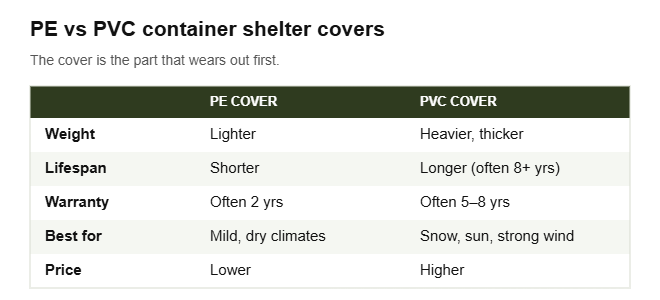
PE (polyethylene) covers are lighter and cheaper, and suit milder, drier climates. PVC covers are thicker and heavier, resist UV, tearing and cold better, and usually carry much longer warranties. As an example, Chery Industrial’s 20ft x 40ft container shelter is offered with 11oz PE or 15oz and 18oz PVC, with a 2-year warranty on PE and 8 years on PVC.
Cover weight is listed in ounces (oz) or grams per square metre (gsm). Higher numbers mean a heavier, tougher fabric.
Step 4: check snow and wind ratings
Every shipping container shelter should list a snow load (in pounds per square foot) and a wind rating (in mph). These numbers decide whether the shelter is safe where you live.
- Snow load: light-duty dome kits may be rated around 20 lb/ft², while heavier-duty kits reach 40 lb/ft² or more. If you get regular heavy snow, choose the higher rating and plan to clear snow before it builds up.
- Wind rating: entry kits are often rated around 40 mph; heavier kits with proper anchoring are rated much higher. Exposed farms and coastal sites need the stronger option.
Your local building department can tell you the design snow and wind loads for your area, and whether a permit is needed for a structure of this size.
Step 5: plan the anchoring
A shipping container shelter is a large sail in high wind, so anchoring matters as much as the frame. The shelter clamps to the containers, and the containers themselves must be secure: on level ground, a solid base or concrete pads, and ideally tied down. Most kits include container clamps and ratchet tensioning straps; concrete bases may need expansion bolts. Follow the manufacturer’s anchoring instructions exactly.
End walls, doors and extras
- Open ends give easy access for vehicles and airflow.
- A back wall blocks prevailing wind and rain.
- Front walls with roll-up doors create a fully enclosed, more secure space.
Also think about lighting, drainage where rain runs off the cover, and whether you want shelving or workbenches inside the containers.
Common mistakes to avoid
Measuring the wrong gap. Confirm whether the kit’s span is measured between inner or outer container edges.
Uneven containers. A height difference between the two containers strains the frame and cover.
Buying on price alone. A cheaper PE shipping container shelter can cost more in the long run if the cover needs replacing early in a harsh climate.
Skipping the anchoring plan. Wind damage is the most common failure. Anchor properly from day one.
Where to buy and how to save
Chery Industrial sells container shelters in several spans and cover options, alongside workbenches, gates and fencing, skid steer attachments, storage shelters and prefab buildings. It is a practical one-stop shop if you are setting up a yard or farm workspace.
Save before you order
Chery Industrial regularly runs percentage-off offers on container shelters, workbenches and other equipment, plus clearance and free-shipping deals. On a larger kit, even a small percentage adds up.
If the shelter will house equipment that needs power, our guide on what size portable power station you need helps you size off-grid power for lights and tools.
Frequently asked questions
What size shipping container shelter do I need?
Match the length to your containers (20ft or 40ft) and choose a span that fits the gap between them. For vehicles or machinery, pick a taller peak height.
Is a PE or PVC cover better?
PVC is thicker, lasts longer and usually has a longer warranty, which makes it the better choice for snow, strong sun or wind. PE is lighter and cheaper for mild climates.
Do I need a permit for a container shelter?
It depends on your location and the size of the structure. Check with your local building department before installing.
Can I install a shipping container shelter myself?
Most kits are designed for DIY assembly by two people without welding. You will need a ladder, basic tools and a safe way to lift the trusses onto the containers.
How long does a container shelter last?
Galvanised steel frames can last well over a decade. Covers wear faster — PVC typically outlasts PE — and can be replaced separately.
The bottom line
A shipping container shelter is one of the cheapest ways to create a large covered workspace. Measure the gap carefully, choose PVC if your weather is harsh, check the snow and wind ratings against your location, and plan the anchoring before the kit arrives. Then check the current codes to take a little off the price.