


Some links in this article are affiliate links. If you buy through them, SaveItMore earns a commission from the retailer — the price you pay is exactly the same. See our affiliate disclosure.
A battery you cannot refill is a battery that empties once. That is the whole argument for pairing a solar panel for portable power station use with the unit itself — during an outage the wall socket is dead, and a panel is the only source that keeps working without fuel, noise or a trip to a petrol station.
The problem is that panel listings are written to flatter the panel. A “200W” panel almost never delivers 200W, and the wattage is not even the number most likely to stop it working with your unit. Here is what actually decides whether a panel and a power station get along.
The one number that must match: input voltage
Before anything else, a solar panel for portable power station use has to be electrically compatible. Every power station has a solar input window, printed on the unit or in the manual as something like “11–60V, 10A max, 400W max”. A panel whose open-circuit voltage sits below the bottom of that window will not start the charge controller at all. A panel above the top of it can damage the input.
This is the mistake that sends panels back. A single small 12V panel often idles at around 18–22V, which is fine. Wire two of them in series and you are at 40V or more; wire four and you are past the limit of many units. Series wiring adds voltage, parallel wiring adds current, and your unit has a ceiling on both.
So the order of decisions is: read the input window first, pick the panel second, and work out the wiring third. Doing it the other way round is how people end up with a panel that reads 0W in bright sun.
Solar panel for portable power station output: rated versus real
Panel wattage is measured under Standard Test Conditions — 1,000W per square metre of light, at a cell temperature of 25°C, with the panel square-on to the sun. Almost nothing outdoors matches that. The US Department of Energy’s summary of solar performance and efficiency explains why: output falls as cell temperature rises, and shade, dirt and angle all take their cut before the electricity reaches the cable.
In practice, plan on 60–75% of the rated figure in good conditions. A 200W panel realistically feeds 120–150W into a station at midday, less in the morning and evening, and far less under thin cloud. Over a clear day a 200W panel might return 700–900Wh, so a 1,000Wh station takes most of a day to refill from empty.
If that sounds disappointing, the fix is not a cleverer panel. It is more panel area, or lower expectations about how fast a big battery refills.
How much panel do you actually need?
Size a solar panel for portable power station use by working backwards from what you are running, rather than forwards from what the panel costs.
- Phones, lights, a laptop, a fan. 100W of panel is genuinely enough — you are replacing 200–400Wh a day.
- A fridge through an outage. A fridge cycles rather than runs, so budget 1–2kWh a day. That wants 300–400W of panel to stay level, not 100W.
- A van or a long trip off-grid. 400W and up, mounted rather than folded, because nobody wants to re-aim a panel four times a day for a month.
If you have not yet worked out the load, start there instead: our guide on what size portable power station you need has the formula and a table of appliance watts, and the panel size falls out of the answer. The Department of Energy’s guide to planning a solar electric system uses the same order for fixed installations: work out the electricity you actually use before you size anything.
A useful rule of thumb: panel watts roughly equal to a fifth or a quarter of the station’s watt-hour capacity gives you a unit that refills in a day. Anything less and the battery slowly loses ground on a cloudy run of days.
Folding, rigid or flexible
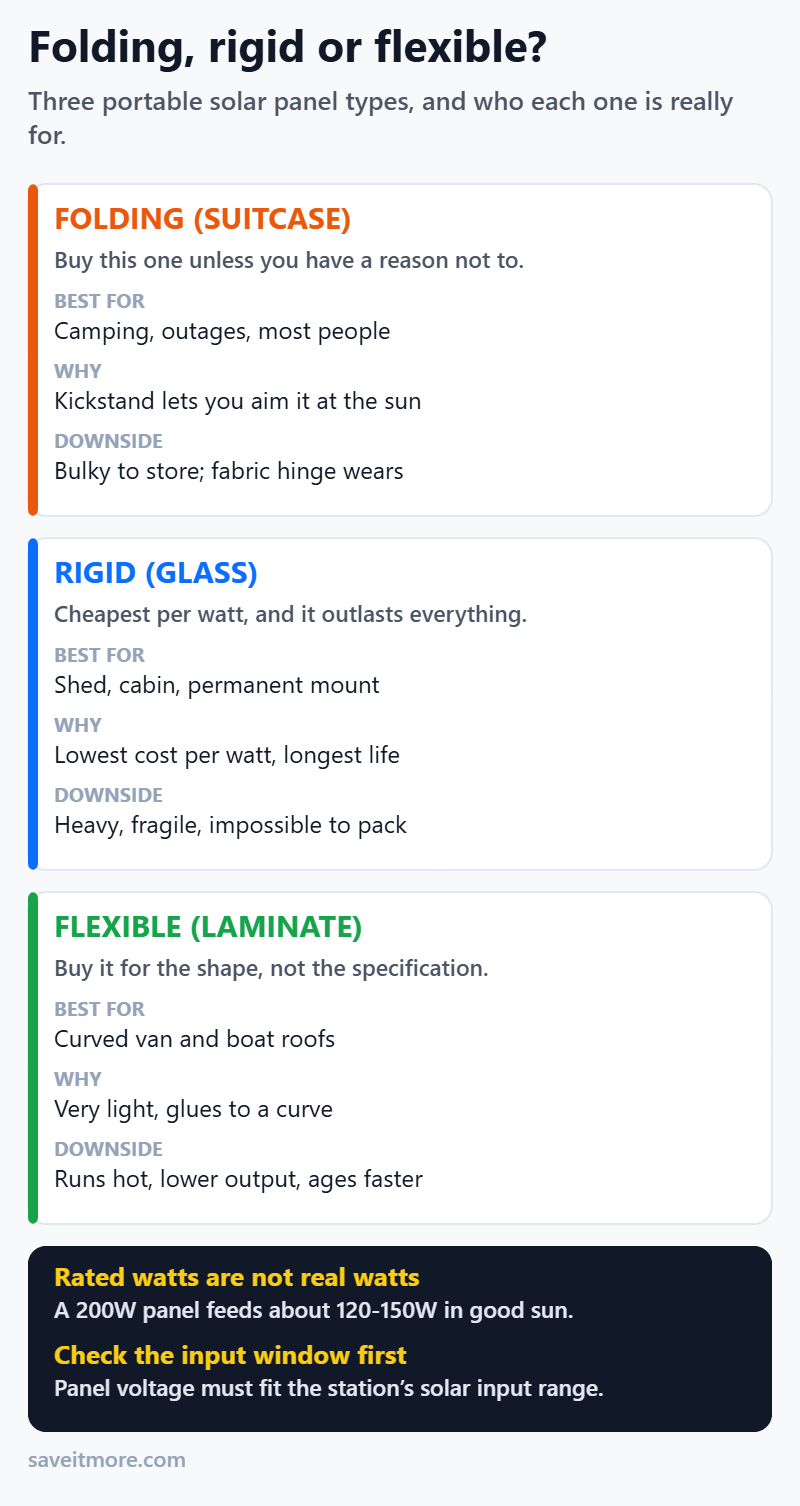
A solar panel for portable power station duty comes in three shapes, and they suit very different lives.
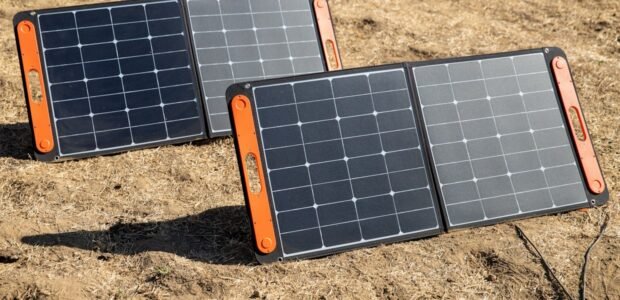
Folding suitcase panels are what most people should buy. They come with a kickstand, fold to the size of a large laptop bag, and can be aimed at the sun — aiming is worth more than extra wattage. The downside is bulk and a fabric hinge that eventually wears.
Rigid glass panels cost the least per watt and last the longest, which makes them right for a shed, a cabin roof or a permanent mount. They are also heavy, fragile in transit and impossible to pack.
Flexible laminate panels glue to a curved van roof and weigh very little. They run hotter than framed panels because there is no air gap behind them, so they give up some output, and they age faster. Buy them for the shape, not the specification.
Connectors, cables and the adapter nobody mentions
The last thing that stops a solar panel for portable power station charging is not electrical at all — it is the plug on the end of the cable. Most panels terminate in MC4 connectors. Most power stations take a barrel plug, an Anderson connector or a proprietary port. The adapter that bridges the two is often not in either box, and a missing adapter is the single most common reason a new panel sits unused for a week.
Three things worth checking before you order:
- The adapter is included, or buy it at the same time. Match the barrel size exactly — 7.9mm and 8mm plugs are not interchangeable in every socket.
- Cable length and gauge. Voltage drop over a long thin extension is real. If the panel has to sit in sun while the station stays in shade, buy the thicker cable.
- Whether the panel has a built-in controller. Panels sold for power stations normally do not, because the station’s own MPPT controller does the work. A panel sold for a 12V battery bank may include one, and doubling up causes problems.
MPPT versus PWM, briefly
With a solar panel for portable power station charging, the charge controller lives inside the station, not the panel, and it comes in two kinds. PWM pulls the panel down to battery voltage and wastes the difference. MPPT constantly hunts for the panel’s best voltage-current combination and typically harvests 15–30% more from the same panel, with the biggest gap in cold or partly cloudy conditions.
Practically every current power station uses MPPT. If you are looking at an older or very cheap unit and the spec sheet does not say MPPT, assume PWM and assume you will lose a quarter of your panel.
Getting more out of the panel you have
- Aim it. A panel tilted square to the sun beats a flat one by a wide margin. Re-aim it two or three times a day and you gain more than a second panel would give you.
- Keep every cell out of shade. Cells are wired in series, so one shaded corner — a branch, a tent guy line, a chair leg — drags the whole string down, not just its own share.
- Let air behind it. A panel lying on hot tarmac runs far hotter than one on a stand, and heat costs output.
- Wipe the glass. Dust and pollen are worth several percent, and bird mess is worth more than that.
- Charge from both sources at once if your unit allows it. Many accept solar and a car socket together, which is the fastest way to recover a flat battery on a grey day.
Solar in the cold
Winter treats a solar panel for portable power station charging strangely: cold is good for panels and bad for batteries. Cell efficiency rises as temperature falls, so a bright cold day is one of the best solar days of all — but most lithium batteries refuse to accept charge below freezing, which means the panel can be producing happily while the station declines to take it. That mismatch, and the way to work around it, is covered in our guide to using a portable power station in cold weather.
Where a panel changes the buying decision
Solar is also the point at which a battery starts to compete with an engine. A power station on its own is a fixed amount of energy; a power station plus a panel is a small generating system that refills every day, silently and indoors-safe. That is the argument our comparison of a portable power station vs generator keeps coming back to, and it is why buying the panel later often turns out to be a false economy.
How to pay less
A solar panel for portable power station use follows the same discount pattern as the stations it charges: the sharpest prices come in bundles, and the worst come immediately after a storm, when demand spikes.
- Buy the bundle. A station-plus-panel kit is almost always cheaper than the two bought separately, and the adapter is included.
- Check the store page before checking out. EcoFlow coupons and deals on SaveItMore lists the current offers, taken from the store’s own affiliate feed rather than a scraped list, and the EcoFlow store itself is where the panel and station bundles sit.
- Price per watt, not per panel. Two 100W panels are usually cheaper and more flexible than one 200W panel, and they can be aimed independently.
- Do not pay for a controller you already own. If the station has MPPT built in, a panel with its own regulator is money spent on a part you will bypass.
Frequently asked questions
Can I use any solar panel with any power station?
No. A solar panel for portable power station charging only works if its open-circuit voltage falls inside the station’s solar input window, and the current has to stay under its limit. Wattage on its own tells you nothing about compatibility.
How long does a solar panel take to charge a power station?
Divide the station’s watt-hours by about two-thirds of the panel’s rated watts, then allow for the sun moving. A 1,000Wh station on a 200W panel is most of a clear day; on a 400W panel it is roughly half of one.
Can I connect two panels to one power station?
Usually yes, with a series or parallel Y-cable. Series adds the voltages, which can push you past the input limit; parallel adds the currents, which can push you past the amp limit. Check both numbers against the unit’s window before you buy the cable.
Do portable solar panels work through a window?
Poorly. Glass cuts a large share of the usable light, and the panel will trickle rather than charge. Put it outside.
Are bifacial or high-efficiency cells worth paying for?
For a portable panel, rarely. Efficiency mainly buys you a smaller panel for the same watts, which matters if you are short of space and not much otherwise.
Can I leave a panel connected all the time?
Yes. The station’s controller stops charging when the battery is full, and leaving the panel attached is how a unit stays topped up between uses.
The short version
Choosing a solar panel for portable power station use comes down to three checks in order: does the voltage fit the input window, is the panel big enough for the load once you knock 30% off the label, and is the right adapter in the box. Get those three right and a folding 200W panel will quietly keep a fridge and a phone alive through an outage. Get the first one wrong and the most expensive panel on the market reads zero watts.